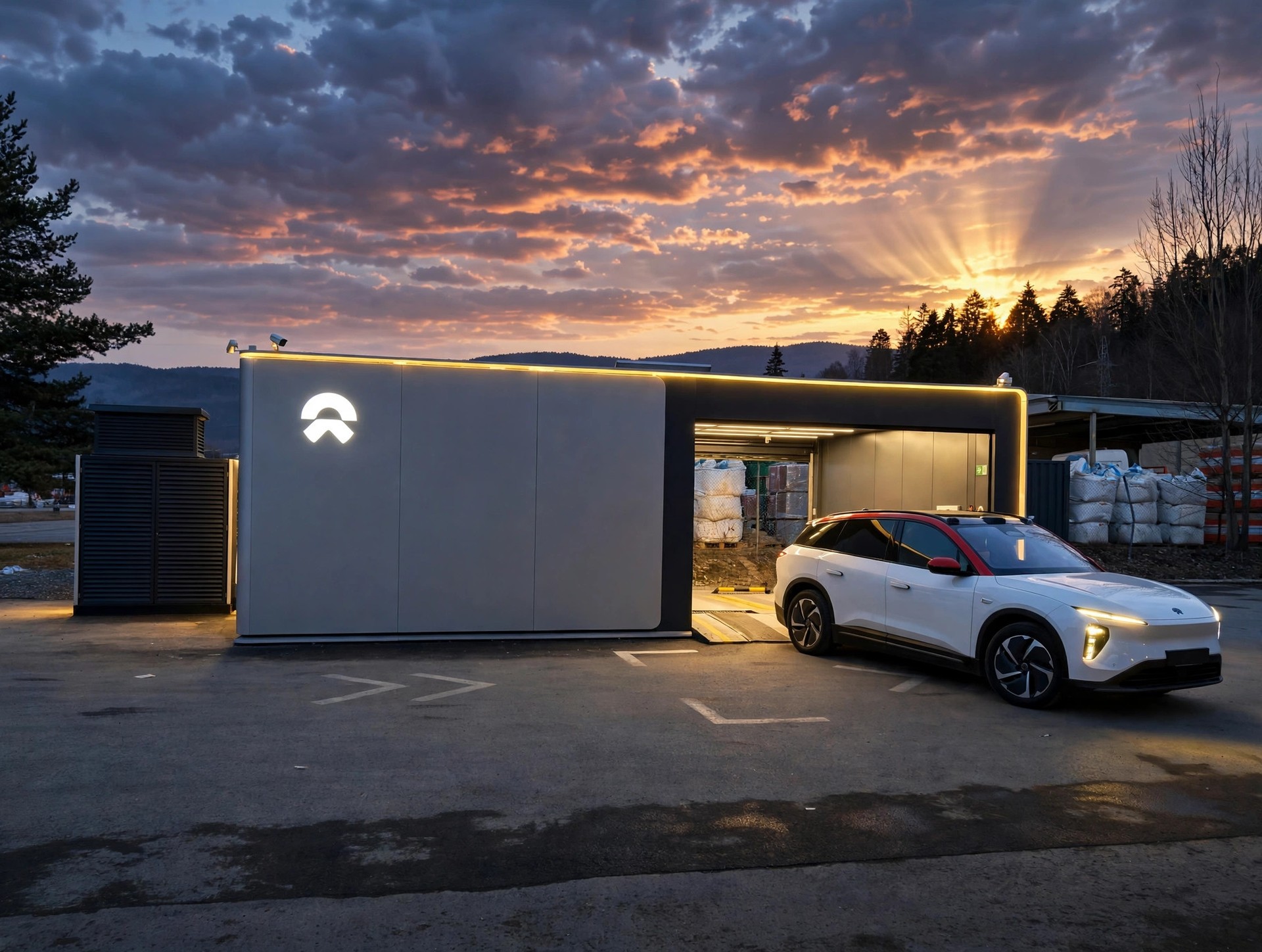

Quick answer: At a NIO Power Swap Station in Europe, the process runs: confirm eligibility and find a station → plan the route → submit the order when near and join the queue → let the car park itself and start the swap → verify and drive off. In the historical tests cited below, successful swap attempts took roughly 5–7 minutes. You stay in the car with the doors closed throughout. Swapping is available to BaaS (Battery-as-a-Service) or NIO Subscription users in Europe (per NIO’s German FAQ) — whether a bought-out battery qualifies depends on current local terms, so check before you count on it. Europe has 59 stations per NIO’s official map as of April 2025 (media-reported; see network section below for dates and caveats).
What follows is the general process for NIO’s European models, based on the European English user manuals for the EL6 and ET5 (details in Sources below). The three independent tests cited used an ET5, an EL6 and an ET7 respectively — button names and screens may differ on other models and software versions, so verify against your car’s manual.
Step-by-step
Step 1 — Confirm eligibility and find a station. In Europe, swap eligibility is described in NIO’s German FAQ as BaaS or NIO Subscription. BaaS pricing on NIO’s German price page is about €169/month for 75 kWh (Germany only — not a Europe-wide figure), plus €10 service fee per swap, two service-fee vouchers per month, and electricity at €0.43/kWh. Before you set off, check the NIO app for your target station’s current status: the network changes — NIO opened its first Belgian station (Edegem) in December 2024, while the Slagelse station in Denmark was removed from the network list in November 2025 after months of unavailability (reported by eletric-vehicles.com as NIO’s first European station closure; the report date is not necessarily the exact shutdown date). If anything looks off in the app, contact NIO rather than trusting an old article.
Step 2 — Plan the route; don’t assume the planner will include swap stations. In electrive’s long-distance EL6 test (trip in November 2024, published December 2024), the planner suggested a 28-minute Aral Pulse fast charge even though a swap station was a few kilometres away, and in cross-border route-planning tests it sometimes offered no swap stations at all. Check the planned route and add swap stations manually where needed. Note the car’s navigation database can lag behind newly opened stations — in AutoBild’s April 2023 cross-border test, the ET7’s voice assistant didn’t recognise the then-new Slagelse station.
Step 3 — Arrive, submit the order nearby, and join the queue. Per the European manuals, a regular swap order can only be submitted when the car is within about 200 metres of the station, and submitting generates a queue number — there is no advance time-slot booking for regular swaps. (Planning a route in advance, submitting a regular swap order, and booking the temporary capacity upgrade are three different processes.) The manuals describe the queue length, estimated wait and called numbers on screen. In electrive’s EL6 test, a NIO employee confirmed the booking remotely before arrival. Use your own account: AutoBild’s test found that logged in as a guest, the app accepts a battery request but automatic swapping is disabled — staff had to trigger the swap from the station touchscreen and the car had to be parked manually.
Step 4 — Let the car park itself and start the swap. Drive to the marked position in front of the station, and on the car’s touchscreen start automatic parking and the battery swap. The car reverses itself in. Stay inside with the doors closed, and don’t shift gears or press the brake during the swap (EL6 European manual, printed pp. 344–345; the manual also notes the central display may switch off after about five minutes to protect the 12V battery).
Step 5 — Wait, then verify before driving off. On timing: NIO’s official FAQ measures about 3 minutes from the first opening of the bottom hatch to its final closing. Independent tests time successful swap attempts differently: 6 minutes 32 seconds for the ET5 at Hilden, Germany (October 2023; 392 seconds, from automatic handover to clearance to drive off — the testers’ full stop was 17 minutes including buying food), about 5 minutes for the EL6 (November 2024 trip, published December 2024), and 6:40 for the ET7 plus a second successful attempt of 5:40 after a 12-minute self-check wait and an aborted retry (AutoBild, April 2023). These tests use different timing boundaries, so they can’t directly verify or refute the official three-minute figure — and none of them include detours to the station, queueing, or retries. When it’s done, confirm the capacity you actually received; if the interface doesn’t show it clearly, verify with NIO before leaving the station.
Common problems, with fixes
1. A door opened mid-swap locked up the whole car. During the AutoBild test, someone opened a door mid-swap to grab a jacket and the entire system froze — it took an hour to recover, and the original report notes the 12V battery eventually needed a jump start. Fix: once the swap starts, nobody opens a door. If it happens, don’t improvise — contact NIO roadside assistance and follow the manual.
2. Wrong-capacity battery fitted. AutoBild’s crew had expected a replacement 100 kWh pack (roughly 450 km of range) but staff fitted a 75 kWh pack — the author found the car then showed a little over 350 km of range — and only realised when the range didn’t add up. Fix: before driving off, confirm the capacity you actually received; if the interface doesn’t show it clearly, verify with NIO before leaving the station. Note that state of charge, displayed range and battery health (SOH) are three different numbers; a range figure alone doesn’t prove which capacity you received.
3. The replacement shows 90%, not 100%. At Hilden, the ET5 received a pack showing 90% even though the app showed fully charged packs in the station’s inventory. NIO’s FAQ states packs are normally charged to about 90%, so this is expected rather than a fault — and per the same FAQ, the station automatically assigns the highest-charged pack of the matching capacity. (A Dutch test reported packs being charged at 20–80 kW in-station to extend their life — reported, not independently measured.)
4. Holiday capacity upgrade: four countries, not five — and extra cost. Since December 2024, NIO Europe has offered a temporary upgrade from 75 kWh to 100 kWh (about 115 km more WLTP range in the reported example — 560 vs 445 km, a 25.8% range gain on a 33.3% capacity gain; example-specific, not valid for all six models). Per NIO’s Dutch FAQ it is available in Norway, the Netherlands, Sweden and Germany — Denmark is explicitly excluded — it must be arranged in the car’s country of registration, and the pack returned to the original pickup station. The Dutch FAQ further limits it to the primary user of a Standard Range BaaS contract and lists additional exclusions such as leased vehicles — being eligible for regular swaps doesn’t automatically mean being eligible for the upgrade. Cost is an extra €169/month on top of the base €169 BaaS, i.e. €338/month in Germany (per NIO’s German upgrade page, which quotes “one month” — not four weeks).
The network’s status, with dates attached
Media reports put Europe at 59 Power Swap Stations — 20 in Norway and 19 in Germany (per NIO’s official map as of April 2025, reported by eletric-vehicles.com on 28 April 2025; treat as a dated count, not a verified live list). Denmark’s only station, Slagelse, was removed from the network list in November 2025 after months of unavailability — reported by eletric-vehicles.com as NIO’s first European station closure (the report date is not necessarily the exact shutdown date) — so Denmark no longer belongs in the current distribution. Cumulative European swaps passed 300,000 by June 2026; the reported pace of one swap every 2.39 minutes covers the whole network’s opening hours in 2026 up to the 24 June report, according to NIO (about 25.1 swaps/hour network-wide) — not per-station speed and not a lifetime average. The “two-thirds of European customers choose swapping” figure is NIO’s own claim, not an independent survey. On expansion: a May 2026 report (based on an attendee’s account from a Dutch owner event, not an official NIO statement) said no new stations or model updates were planned; the late-2027/early-2028 timeframe in that reporting referred to NT3 models, and no restart date for station construction was given. In September 2026 Geely agreed to take 30% of Nio Power — via all of YiYi’s equity plus RMB 640 million in cash, subject to closing conditions (NIO Form 6-K, 28 September 2026, p. 4). The September deal announcement gave no European deployment details, though a 29 September report quoted CEO William Li saying joint European swap-network plans for 2027 had been discussed. Practical takeaway: the network works where it exists, but verify your regular stations in the app before relying on them.
Sources
NIO official (European English manuals, downloaded 21 October 2026; no explicit revision number found — cited by filename, language version and download date): EL6 manual en_EU/EL6_EN.pdf (printed pp. 341–345; PDF pp. 347–351) and ET5 manual en_EU/ET5_EN.pdf (printed pp. 332–336; PDF pp. 338–342) — order submission within ~200 m, queue numbers, auto-parking handover, doors-closed/shift/brake requirements. NIO German FAQ — standard hours 7:00–22:00 (changes shown in app/navigation), 3-minute timing definition, BaaS/NIO Subscription eligibility, automatic assignment of highest-charged matching pack, packs normally charged to ~90%. NIO German BaaS price page — €169/month (Germany), €10/swap service fee, two monthly vouchers, €0.43/kWh. NIO German flexible-upgrade page — extra €169/month (€338 total). NIO Dutch FAQ — upgrade countries and Denmark exclusion, registration-country/return-station rules, Standard Range BaaS primary-user limitation.
Independent media tests: electrive ET5 test, Hilden, Germany (11 October 2023, updated 24 October) — 6:32 timing, 90% replacement pack; electrive EL6 long-distance test, Germany (trip November 2024, published 5 December 2024) — ~5 minutes, remote confirmation, planner quirks; AutoBild ET7 cross-border test, Hamburg–Scandinavia (6 April 2023, original reporting) — guest-account trap, wrong-capacity pack, door-open freeze, 6:40 and 5:40 runs; DrivOlution ET5 test, Netherlands — in-station pack charging at 20–80 kW (reported).
Network and business reporting: eletric-vehicles.com, 28 April 2025 — 59 stations / Norway 20 / Germany 19 per NIO’s official map; eletric-vehicles.com, 12 November 2025 — Slagelse removal, first European closure per report; eletric-vehicles.com, 27 May 2026 — no new stations/updates per event attendee account; eletric-vehicles.com, 24 June 2026 — 300,000 swaps, 2.39-minute network pace; newmobility.news, 4 December 2024 — holiday upgrade pricing; newmobility.news, 29 September 2026 — Geely stake; eletric-vehicles.com, 29 September 2026 — CEO on 2027 joint-network discussions; NIO Form 6-K, 28 September 2026, p. 4 — deal structure; NIO news, 12 December 2024 — Edegem, Belgium station opening.
On battery health basics, see our guide on whether to charge an LFP battery to 100% weekly (follow your own model’s manual — it doesn’t imply NIO packs need weekly full charges), and for winter trips our winter preconditioning guide (fast-charge preconditioning doesn’t transfer directly to swapping).