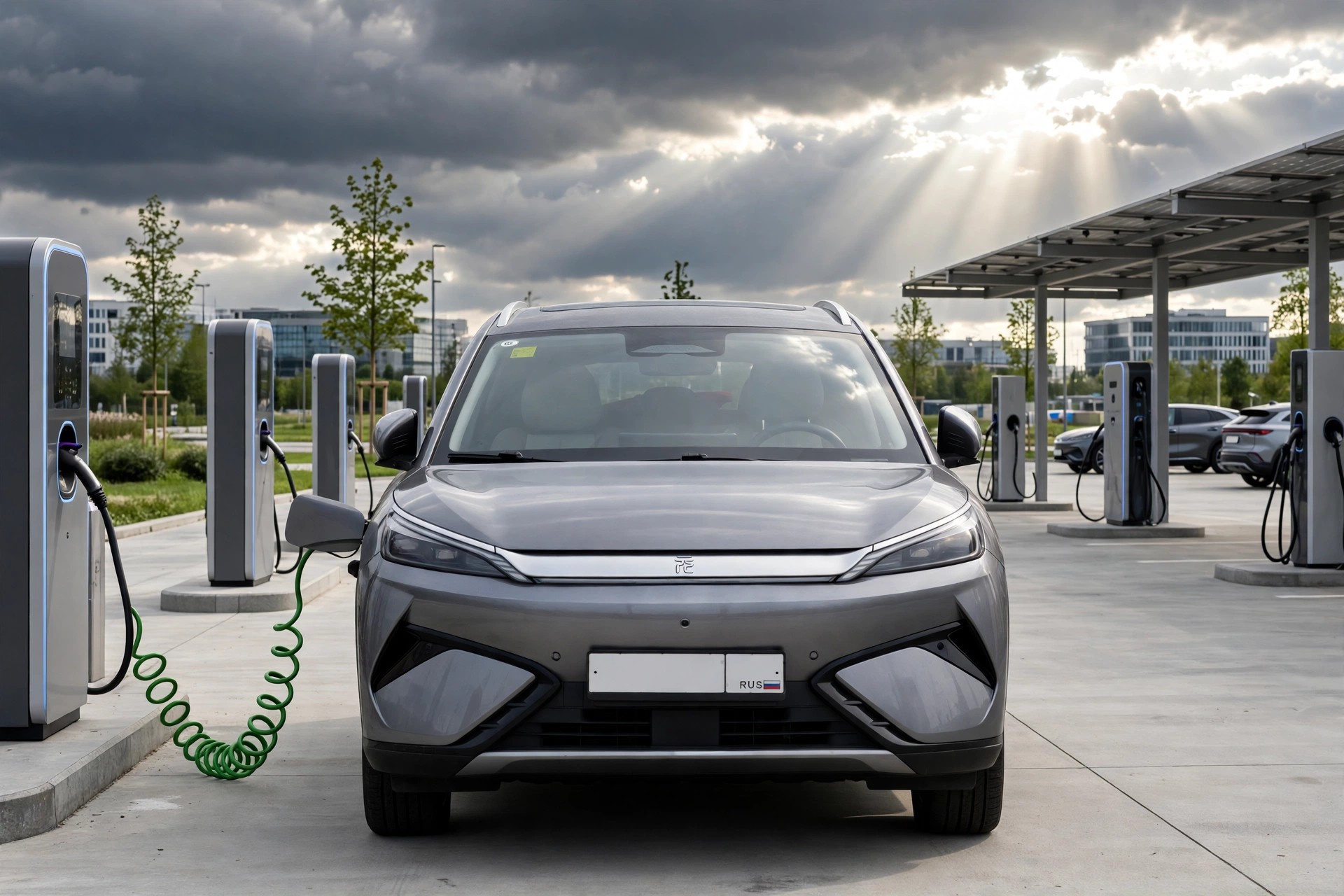

If your EV runs on an LFP battery — a BYD with the Blade Battery, or an MG4 Standard Range — your owner’s manual may ask you to charge it to 100% at least once a week. One manual separately calls for a full charge-and-discharge cycle for battery self-calibration. The MG4 and BYD manuals state their schedules without explaining the mechanism. Tesla’s 2023 Model 3 manual is more explicit about the benefit: it says the guidance maximizes available range and improves the vehicle’s ability to determine state of charge (SOC) and estimated range accurately, but does not explain the internal mechanism. Below is what they actually ask for, one plausible technical explanation, and why in most cases you should drive soon after rather than park at 100%. But before you copy any of this, check your own manual — the wording differs by model and market, and not every LFP car is told to do this.
What the manuals actually say
Most owners never read the charging section of their owner’s manual. Here is what selected Australian, Irish and US owner manuals actually say — each limited to its own model and version:
MG4 (Australia owner’s handbook): recommends charging to 100% at least once a week as part of battery maintenance. It also describes a periodic low-power full charge every 3 to 6 months — the original wording (“a low-power (less than 10% or 1 grid) full charged”) is ambiguous; we read it as discharging below 10% before the full charge. That is our reading, not a literal quote. Separately, the manual describes a monthly equalisation charge on a low-power AC charger for cell balancing — don’t confuse the two.
BYD Dolphin (Ireland owner’s manual, right-hand drive): recommends charging to 100% at least once a week — and, like the MG4, a deeper cycle every 3 to 6 months: when SOC falls below 10%, charge fully to 100%. (The manual doesn’t specify slow charging for this cycle; low-power charging is its general recommendation for battery life.) The same manual describes a separate full charge-and-discharge procedure at least every 6 months or 72,000 km — whichever comes first — explicitly as battery self-calibration.
An MG Motor UK email, reposted by an owner (mgevs.com): their customer service wrote that equalisation charging “as often as you can manage” is better than every 3 months — weekly or bi-weekly. Note: this is an owner-reposted anecdote, not a technical document with the same weight as the manual.
And here is the detail most articles miss: one car’s software reminded its owner. One BYD Dolphin Mini owner reported receiving a 100% charge reminder — the dashboard displayed a recommendation to charge to 100% after a stretch without a full charge (via a Brazilian long-term test) — a single owner-reported nudge from the car’s software on one model, not a universal timed reminder.
The plain-English explanation: why LFP is different
LFP (lithium iron phosphate) cells have an extremely flat open-circuit voltage curve: across the middle of the SOC range, voltage stays near the nominal 3.2 volts per cell, climbing steeply only at the very top and dropping steeply at the very bottom. The exact flat region and voltage vary by cell and conditions, and the curve exhibits hysteresis — so treat this as a characteristic, not a universal fixed range.
That flatness is a central part of the explanation. A BMS may combine measurements such as current, voltage, and temperature with estimation methods such as coulomb counting and battery models. Across much of an LFP cell’s middle SOC range, the flat OCV curve makes voltage alone a weak SOC signal. Coulomb-counting errors can accumulate over time if the estimate is not corrected, so the displayed SOC can drift.
A full charge to 100% can give the BMS a useful reference point for its SOC estimate — the top of the curve is a reference endpoint. Note that the manuals state the schedule without always spelling out the mechanism: the MG4 handbook gives a maintenance reason for weekly charging; the Dolphin manual separately recommends low-power charging for battery life, but gives no mechanism for its weekly full-charge schedule. Tesla is the exception here: its 2023 Model 3 manual says this guidance helps the car determine SOC and estimated range accurately — but does not explain the internal mechanism. The full-charge endpoint is one plausible explanation. Call it SOC calibration if you like — giving the BMS a useful reference point for its SOC estimate. Tesla makes the same weekly-100% recommendation in its 2023 Model 3 owner’s manual (US) for the LFP version — with a nuance on the charge settings: it also suggests keeping the daily charge limit at 100%. If the car will not be driven for weeks, the manual suggests leaving it plugged in. It also says that if the car has been parked for more than a week, you should resume normal driving and charge to 100% when convenient. Separately, Tesla’s current (2024+, software 2026.32) battery guidance — from a different, newer manual version — gives long-term storage guidance: around 50% charge, plugged in if possible, with the charge limit set to 50%. These come from different manual versions, so always follow the manual matching your own car and model year. One caveat: reaching the top gives the BMS one calibration endpoint — it does not guarantee that every car’s SOC estimate snaps back to perfect accuracy.
There is a second, separate mechanism near the top of charge: cell balancing. A battery pack is many individual cells, and their states of charge can drift apart slightly over time. Many packs do their balancing near 100% — the MG4 handbook describes entering an equalisation mode after normal charging completes. But balancing implementations differ by model (passive vs. active, when they trigger), and balancing is a different job from SOC calibration — don’t conflate the two. If your manual specifies an equalisation sequence, finish it before you drive off.
The other half of the truth: don’t park at 100%
Here is where the internet’s advice gets sloppy. “LFP loves 100%” is true only as an event, not as a state.
Cycling tests published in the Journal of the Electrochemical Society found that repeated cycling at higher average states of charge led to more capacity fade in LFP cells than cycling at lower SOC — the researchers attributed this in part to increased side reactions at the graphite negative electrode at higher SOC, and in part to lithium-alkoxide-related iron dissolution and deposition that further depletes the lithium inventory. Those were cycling tests — LFP/graphite pouch cells at 40°C/55°C, laboratory conditions — not cars parked at 100%, so the finding has limits. On the parked-car question, calendar-aging research on LFP/graphite cells found that storage temperature is the dominant factor, with state of charge a meaningful secondary one — which is why the advice targets long, hot stays at high charge specifically.
Experienced owners land in the same place. On Australia’s AEVA forum — in a thread started by a 2021 Kona EV owner (an NMC car, not LFP) — experienced posters advise against leaving the car at 100% for long. Separately, an LFP calendar-aging study shows that heat increases storage-related capacity loss. Taken together, the owner-thread advice and the LFP calendar-aging research point in the same direction: long stays at high state of charge increase calendar-aging risk, and repeatedly cycling at high SOC adds fade too — so the practical advice is about reducing high-SOC dwell time, not a claim that a brief stop at 100% is entirely free of cost.
So the honest routine is: charge to 100% near departure, then drive — and if your manual specifies equalisation steps, complete them first. Plan the full charge for the night before a longer drive, not for a car that will sit in the driveway until Friday.
What this means for your car
Does it apply to you? First, confirm your battery chemistry — and note that it varies by market, year, and trim. In Australia, for example, the 2026 MG4 EV Essence 64 is LFP while the XPower is NCM, so don’t assume “64 kWh means NMC.” BYD models equipped with the Blade Battery — Atto 3, Dolphin, Seal, Sealion 7, and the Dolphin Mini/Seagull/Atto 1 — use LFP chemistry; availability and trim details vary by market and model year. Then check your manual’s charging section: if it asks for periodic full charging, follow that schedule — not a rule lifted from another car’s manual.
What happens if you never charge to 100%? The concern is that the displayed SOC estimate can drift — and don’t assume a full charge will always fix every case. The point is narrower: skipping these routines may make the SOC reading less trustworthy over time. That is a reasonable technical interpretation, not a confirmed purpose — the only explicit “battery self-calibration” label in the manuals we cite is on the Dolphin Ireland manual’s separate full charge-and-discharge procedure.
The routine that covers everything — with the caveat that the “why” below is the technical interpretation, not a line from any manual:
- If your manual asks for a weekly (or similarly periodic) full charge: do it, and drive soon after — complete any equalisation steps the manual specifies before driving off.
- If your manual describes a periodic low-SOC full charge in clear wording (for example, the Dolphin Ireland manual’s sub-10% full charge every 3–6 months), follow that schedule as written — don’t add conditions the manual doesn’t mention. Note: the MG4 handbook’s low-power full-charge passage every 3–6 months is ambiguously worded — our reading, needs manufacturer confirmation — so it is not listed here as a routine.
- If your manual names a separate self-calibration cycle (the Dolphin Ireland manual’s full charge-and-discharge at least every 6 months or 72,000 km, whichever comes first), treat it as its own item — it is the one routine the manuals explicitly label “battery self-calibration.”
- For daily driving, the middle of the range is fine — you don’t need to live at 100% — unless your manual specifies a different daily limit (Tesla’s 2023 Model 3 LFP manual suggests keeping the daily charge limit at 100%).
- If the car will sit unused for weeks, follow your manual’s storage guidance first — e.g. the MG4 Australian handbook says long-term storage SOC should not drop below 50%, with a top-up charge at least every 3 months; the Dolphin Ireland manual says keep SOC at 40%–60% if the car sits unused for more than 7 days, and if it sits for more than 3 months, fully charge it every 3 months and then leave it at 40%–60%. As a general rule, don’t park it full. Tesla’s current (2024+) manual gives separate long-term storage guidance: around 50% charge, plugged in if possible, with the charge limit set to 50% — follow the manual matching your car and model year.
- Before copying any of this from a different car’s manual, read your own.
Why this matters beyond the manual
For LFP vehicles whose manuals call for periodic full charging, a full-charge endpoint can help the BMS correct its SOC estimate, and some packs also balance cells near the top of charge. The schedule and balancing procedure vary by model. To limit time at high charge, plan the session near departure and complete any equalisation steps specified in the manual.
Sources
Manufacturer manuals
- BYD official Blade Battery technology page — Blade Battery models use LFP chemistry: media.byd.com/section/technology/blade-battery
- MG Australia MG4 EV specifications (2026 model year) — Essence 64: LFP; XPower: NCM: mgmotor.com.au/vehicles/mg4-ev
- MG4 EV Owner’s Handbook (Australia) — weekly full charge; periodic low-SOC full charge every 3–6 months (original wording ambiguous; our reading, not labeled “recalibration” by the manual); monthly equalisation charge; long-term storage: SOC not below 50%, top-up at least every 3 months: mgmotor.com.au/brochures/MG4_EV_Owners_Handbook.pdf
- BYD Dolphin owner’s manual (Ireland, right-hand drive) — weekly full charge; sub-10% to 100% full charge every 3–6 months: bydauto.ie/assets/1/owners/owners-manuals/byd-dolphin-owners-manual-right-hand-drive-en.pdf
- Tesla Model 3 owner’s manual (US, 2023) — weekly 100% charge for the LFP version: MC-10238121-9999.pdf; Tesla’s current (2024+, software 2026.32) storage guidance (around 50%, limit set to 50%): tesla.com storage guidance (manual homepage for version check)
Research
- LFP SOC estimation study — flat OCV curve, hysteresis, and estimation approaches: doi.org/10.1021/acsenergylett.4c03223
- Journal of the Electrochemical Society — cycling tests at different SOC ranges and LFP aging; higher average SOC cycling led to more capacity fade; increased side reactions at the graphite negative electrode at higher SOC: doi.org/10.1149/1945-7111/ad6cbd (cycling tests, not parked-car calendar aging)
- LFP calendar-aging study (Grolleau et al., commercial graphite/LFP cells) — storage temperature dominant, SOC a meaningful factor: doi.org/10.1016/j.jpowsour.2013.11.098
Owner reports
- MG Motor UK customer service guidance on equalisation charging — owner-reposted email via mgevs.com; anecdote, not a technical document
- AEVA forums (Australia), “Charge to 100%?” — thread started by a 2021 Kona EV owner (NMC, not LFP); owner discussion on LFP flat voltage curve and coulomb counting: forums.aeva.asn.au/viewtopic.php?t=9399
- BYD Dolphin Mini dashboard 100% charge reminder — Brazilian owner report: quatrorodas.abril.com.br