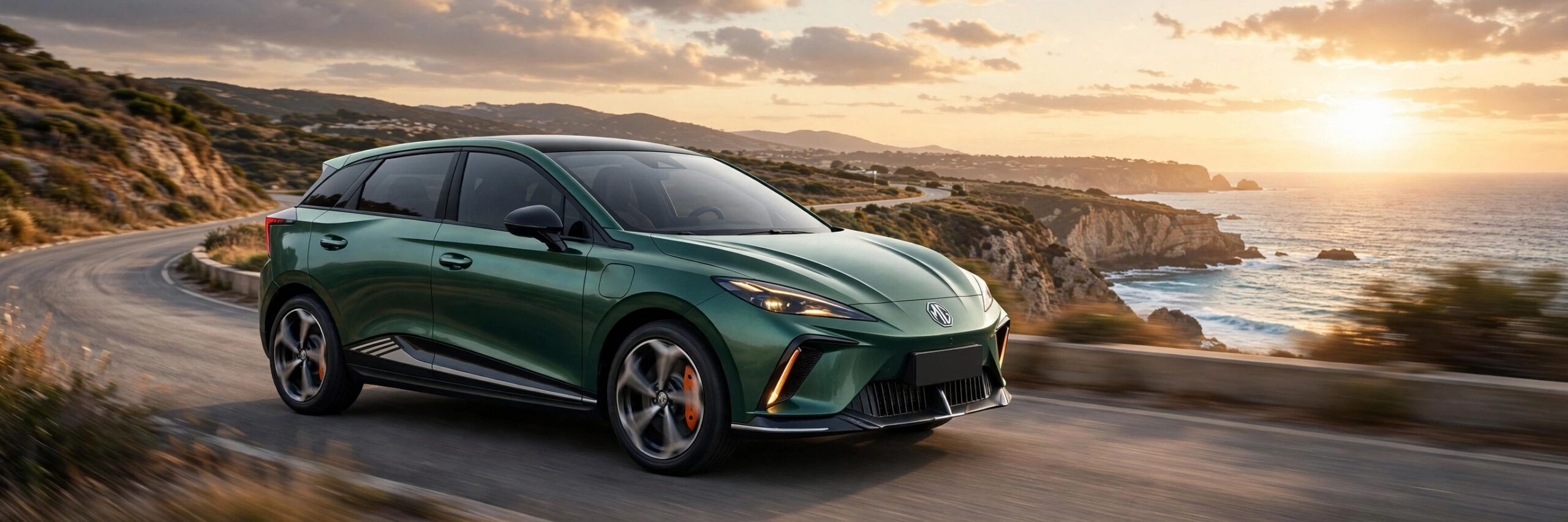

Verdict: The MG4 XPower is worth it if what you actually want is supercar-style straight-line acceleration in a practical hatchback, and you can live with roughly 180–210 miles of extrapolated range (see the calculation note below — this is a 100%-to-0% extrapolation from reported efficiency, not a guaranteed daily range). It is not worth it if you want a true hot hatch — one that rewards you in corners, rides well every day, and feels special inside. For buyers whose priority is value and range over outright pace, the cheaper single-motor MG4 is the better car; the XPower is the better party trick. That distinction, not the 0–100 km/h time, is the whole buying decision.
Scope, as of 25 October 2026: this review covers the export-market MG4 XPower (dual-motor all-wheel drive, 64 kWh nominal) sold in the UK and Australia. UK and Australian prices and specifications are labelled separately and must not be mixed, and pre-2026 and 2026-model-year (MY26) figures are labelled separately. The 2026 updates in both markets changed the cabin, so older reviews of the interior do not describe MY26 cars. Chinese domestic-market MG4 variants are outside this review. The 61.8 kWh usable figure used in the calculations below is reported for the earlier 64 kWh version; it is used here as an estimate, not as a verified MY26 figure.
What you are actually buying: 320 kW in a family hatchback
The numbers are not in dispute. Two motors — 150 kW at the front and 170 kW at the rear in the Australian 2026 specification — give a combined 320 kW (429 bhp) and 600 Nm, with 0–100 km/h quoted at 3.8 seconds. In the Autocar review published 31 March 2025, MG fitted ventilated 345 mm brakes front and rear, springs stiffened by about 15% at the front and 10% at the rear over the standard car, retuned steering and brake-based torque vectoring. Autocar also notes the absence of a proper mechanical limited-slip differential, listing it among the missing hardware; this review does not claim that single omission alone causes the handling character described below. These chassis figures are attributed to that Autocar review; the test car’s model year was not verified for this review, and the publication date does not imply the test car’s model year. They are not presented as verified Australian MY26 specifications.
On paper, acceleration is what you are paying for with this car; this review makes no price-ranking claim against rival models. In Australia, the 2026 XPower is listed at $47,990 drive-away, against $39,990 drive-away for the single-motor Essence 64 — an $8,000 step. That 2026 price is itself a sharp cut from the 2025 XPower’s $55,990 before on-road costs. In the UK, MG announced the 2026 MG4 EV XPower from £33,995 (the wider 2026 MG4 EV range starts at £29,995 for the Premium Long Range); earlier UK XPower list figures reported during 2025 ranged from £34,495 (Carwow) to £36,495 (Autocar’s test car). Prices are therefore quoted here by date and source, not as a single current price; check the deal in front of you.
The case for it: the acceleration, and the practicality
The reviews cited here agree on the straight line. Carwow calls it “sports car-rivalling acceleration at family-sized hot hatch pricing”; TotallyEV gave it a Best Buy award on that basis (TotallyEV XPower review, published 1 December 2023, UK market: link). The all-wheel-drive grip puts the power down cleanly, the steering weights up satisfyingly in Sport mode, and that makes a family hatchback feel violent off the lights.
Crucially, the XPower gives up almost nothing practical against a regular MG4: the same five seats and the same hatchback shape. Boot figures differ by market and measurement method — Australian MY26 lists 350 litres, while the UK sales specification lists 388 litres measured to the roof — so do not compare the two numbers directly. If your daily car must also do school runs and supermarket trips, this is not a compromised weekend toy — it is a normal car that happens to be absurdly fast. That is a genuine, rare combination, and it is why so many owners forgive the rest.
The case against it, part one: the range bill arrives on the days you use the performance
The XPower and the single-motor 64 kWh cars share a 64 kWh nominal capacity, but not the same battery chemistry: the Australian MY26 Essence 64 uses an LFP pack, while the XPower uses an NCM pack. Official WLTP range is 405 km in Australia for MY26, and 251 miles in the UK for MY26 (239 miles was the earlier UK figure). Real-world figures are consistently lower. Independent tests reported efficiencies of 3.3 miles per kWh and 2.9 miles per kWh on a mixed route; the 211-mile and 185-mile figures sometimes quoted from those tests are extrapolations using the nominal 64 kWh, not measured empty-to-full runs. Recalculated on the earlier version’s 61.8 kWh usable figure: 61.8 × 3.3 = 203.9 miles; 61.8 × 2.9 = 179.2 miles. Those are 100%-to-0% extrapolations, so treat roughly 180–210 miles as an indicative band for mixed driving, not as a guaranteed daily range and not as the headline figure.
Owner reports point the same way. One MG4 XPower owner on PistonHeads reports about 3.8–4.2 mi/kWh at a steady 60 mph, falling to about 3.0 at 70 mph — roughly 185 miles at motorway speed on the same extrapolation basis. If your regular round trip is 200 miles with no charging at the far end, this car may need a charging stop. The single-motor car, with the same nominal capacity and one fewer motor to feed, does not punish you the same way.
Charging itself is fine rather than class-leading: the Australian MY26 XPower is listed at a 140 kW DC peak, with 10–80% quoted at about 30 minutes at 25°C (MG Australia MY26 brochure, p.21). Earlier UK tests reported different peaks (up to 144 kW), so do not quote a single DC figure across markets and model years. That is acceptable, but it does not rescue a short-range car on long trips — it just makes each stop shorter.
The case against it, part two: fast, but not engaging
This is where the verdict turns. Carwow’s summary is blunt: “you may outrun a Honda Civic Type R or Hyundai i30 N, but you won’t have as much fun in the twisty stuff.” CarsGuide’s long-term tester of the 2025 model (CarsGuide long-term part 2, published 23 February 2025, Australian 2025 model), whose car’s odometer read 8,283 km at the time of that update, reached the same place: the power is “absolutely ridiculous”, the car feels “entirely competent — if not massively engaging — in corners”, the suspension is “tightened up to 11” on mountain roads and punishing over expansion joints near home, and the cabin is “no better than the cheaper models” (a 2025-model cabin judgement, not a verdict on the MY26 interior). His conclusion: “why not get a cheaper one with more driving range, and make do without the zero-to-100 km/h highlights?”
Autocar’s instrumented verdict is harsher still: a “curiously one-dimensional device” that feels “slightly sketchy and a little unfinished to drive”, with chassis composure and driver engagement below what the power promises. The comfort-biased Bridgestone Turanza T005 EV tyres — a grand-touring tyre on a 320 kW car, as Autocar and owner reports both note — are part of that story. Reviewers and owners also report a firm, unsettled ride, wind noise at motorway speed, and a front-motor whine. None of this makes it a bad car. It makes it a car whose headline number flatters its driving experience.
One owner issue to check before you buy: high-speed vibration and tyre pressures
Owner reports collected by Australia’s MG4 knowledge base describe a 100–120 km/h vibration on some XPower cars, with several owners reporting that raising cold tyre pressures to about 40–41 psi — above the 37 psi placard figure — largely removed it, at the cost of a harsher low-speed ride. One owner also found the dashboard reporting 2.7 bar while a hand gauge read only 36 psi on the same tyre.
Treat this correctly: it is owner-reported mitigation, not a confirmed defect and not a repair. If you test-drive an XPower, take it to motorway speed, check pressures with your own gauge rather than trusting the dashboard alone, and ask the dealer what steps apply to that car. Do not buy on the assumption that a pressure tweak fixes every vibration. No manufacturer bulletin is cited here because none was verified for this review.
Who should buy it, and who should not
Buy the XPower if: you charge at home, your regular trips fit inside roughly 180 miles, you value straight-line punch over cornering feel, and you accept a firm ride and, on pre-MY26 cars, an ordinary cabin (the MY26 cabin is a different interior, addressed above). At the 2026 Australian price, $8,000 over the Essence 64 is a defensible price for all-wheel drive and that acceleration — provided you go in with your eyes open about range.
Do not buy it if: you regularly drive 200-plus miles without charging, you want a car that rewards you on a twisting road, or you expect the cabin (on pre-MY26 cars) and ride to feel like a $48,000 car. In those cases the single-motor MG4 — cheaper, longer-legged, softer — is the better MG4, and a petrol hot hatch or a more engaging EV rival is the better driver’s car. One reviewer’s alternative is worth quoting directly, with its market limit: in the UK, save the money and take the regular MG4 Extended Range (77 kWh), which “looks just as good and is a better all-round car” — noting that Australia’s 2026 new-car range no longer includes a 77 kWh MG4, so that option there means the used market.
Used buyers, one extra check: the 2026 Australian update brought a new 12.8-inch touchscreen, a 10.25-inch driver display and more physical buttons — a direct answer to the old cabin’s biggest complaints. A pre-2026 car will not have that cabin. Check the actual software version fitted to the car you are buying, rather than assuming it from the model year, and check the actual car, not the model name.
So: is the MG4 XPower worth it? As a performance bargain, yes — at the Australian and UK prices cited here, it offers this speed for the money quoted. As a hot hatch, no — it is fast without being truly engaging, and on the days you use that performance it charges you for it in range. Buy it for the launch. Do not buy it for the corners, and do not buy it if your life needs 250 miles without thinking. If you are unsure which buyer you are, the cheaper MG4 answers the question for you: drive both, and notice which one you miss the day after.
Sources and applicability: Australian MY26 specifications, battery chemistry and 140 kW charging from the MG Australia MG4 EV MY26 brochure V2 (April 2026, p.21: link); 2026 Australian pricing from CarExpert (10 April 2026: link) and Drive (April 2026, Australian MY26: link); UK 2026 launch pricing from MG UK (link); UK chassis verdict from Autocar (review published 31 March 2025, UK market; test-car model year not verified: link); efficiency from Not A Guru (link) and Carwow (link) tests; owner experience from mgevs.com (XPower review thread, range thread), PistonHeads (buying thread) and the Zoomy MG4 knowledge base (link, Australian and UK owner reports, not manufacturer statements; the entries cited there are undated in that knowledge base and their model-year applicability is not stated, so they are treated here as owner reports only). UK and Australian, and pre-2026 and MY26, figures are labelled by market and model year throughout; pre-2026 cabin criticism does not apply to the 2026 interior updates. Related reading: our MG4 winter battery-preconditioning guide and our BYD Dolphin long-term review, which shows what a rival’s ownership trade-offs look like after two years.