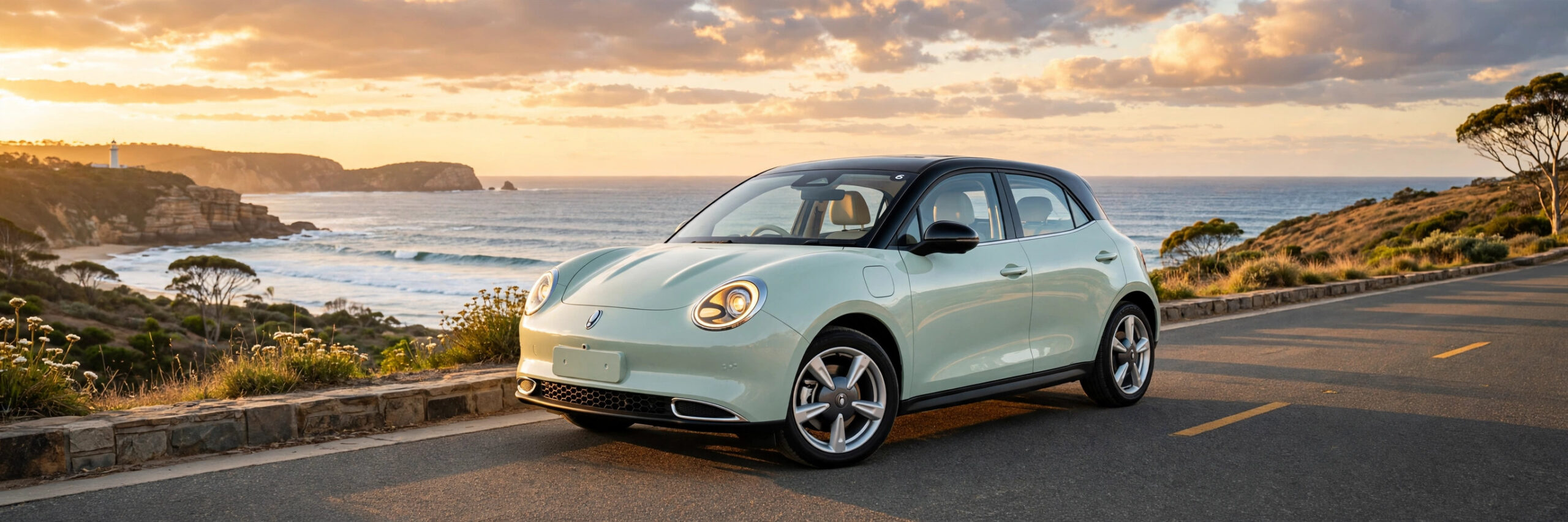

Quick answer: In Australia, the car you are shopping for is sold simply as the GWM Ora hatch — the “Good Cat” name belongs to other markets, and the newer Ora 5 is a different, larger SUV. At its 20 August 2025 launch announcement, the 2026 Australian hatch was priced from $35,990 drive-away for the Lux, with a claimed 400 km WLTP range from a new 57.7 kWh LFP battery. Treat the WLTP figure as a laboratory-cycle result, not a highway promise, and confirm current dealer pricing before you sign anything.
Observation date: 26 October 2026. Prices below are the launch prices announced on 20 August 2025, not a re-checked current dealer price. Specifications are the 2026 Australian specification from that announcement, cross-checked against the GWM Australia Ora brochure dated 2 September 2025 (version GWMA 20250902).
1. Is it still called the Good Cat in Australia?
No — not on the Australian price list. GWM Australia sells it as the GWM Ora. “Good Cat” is the name used in markets such as Thailand and Malaysia, and “Funky Cat” was the name used in the United Kingdom. They are the same retro-styled hatch family, but trim, software and charging details differ by market, so a UK or Thai owner report does not automatically describe the Australian car.
There is a second trap in 2026: the Ora 5 SUV. It shares the Ora badge and a similar 58.3 kWh battery size, but it is a separate SUV with 150 kW, a claimed 435 km range and 120 kW DC charging. None of those Ora 5 figures apply to the hatch in this article.
2. How far will the 2026 Lux really go?
The headline is 400 km WLTP for the Lux and 380 km for the GT. Both the range and the consumption figures are WLTP figures (brochure p.30 lists 160 Wh/km for Lux/Ultra and 177 Wh/km for GT as WLTP consumption), so do not treat a back-of-envelope division as a forecast. For reference only, that division gives 57.7 ÷ 16 × 100 = 360.6 km for the Lux and 57.7 ÷ 17.7 × 100 = 326.0 km for the GT — below the WLTP range figures. This division cannot be used to explain the official figure gap or to forecast actual range. Use WLTP as a standardised comparison figure, not a prediction of your trip range, and keep a buffer for headwinds, hills and cold mornings, and learn your own consumption before committing to long legs. That caution applies to any small-battery car at highway speed, not only to the Ora.
Separately, one Australian owner of a 2024-purchased old long-range car (the old 420 km version, not the new 57.7 kWh battery) covering about 37,000 km in two years, including a weekly interstate trip of about 186 km each way, reported the range estimator falling only from about 420 km when new to about 412 km. Treat that as one owner’s dashboard reading for the old car, not a measured battery-health test and not evidence about the new battery’s durability.
3. Is $35,990 drive-away good value, or cheap for a reason?
At the 20 August 2025 launch announcement, the 2026 Australian drive-away prices were: Lux $35,990, limited-edition Ultra $37,990 (30 cars, Aurora Green with a black roof), and GT $38,990. The GT costs $3,000 more than the Lux and gives up 20 km of claimed range (380 km versus 400 km) for sportier trim, so buy it for looks and equipment, not for range.
What the money buys: a 126 kW / 250 Nm front motor, 0–100 km/h in a claimed 9.0 seconds, vehicle-to-load at up to 6 kW, a heat pump air-conditioning system, and — new for 2026 — GWM Connected Services with scheduled charging. What it does not buy: a big boot. At 228 litres with the rear seats up (858 litres folded), it is smaller than many rival hatchbacks, and the 9.0-second sprint is slower than the old car’s claimed 8.4 seconds. The 2026 car’s kerb-weight range is listed as 1,650–1,670 kg, against 1,540–1,580 kg for the old car; this article does not claim a single whole-range weight increase or a proven causal link between weight and the slower sprint time. If you regularly carry a pram, a large dog crate or four adults plus luggage, check the boot in person before anything else.
4. Can it do a long road trip?
Yes, with planning — and the planning matters more than the badge. One Australian owner’s account, published 20 October 2026 and describing a December Melbourne-to-Uluru trip in a 2023 Ora Cat extended version (the old 420 km car, heavily laden), shows why: a charger listed at Glendambo did not work for their car on either pass, chargers at Marla had no cables of their own (you need your own three-phase cable), and at powered campsites the car gained only about 10 km of range per hour. A big, well-equipped NRMA site at Erldunda was the relief stop. The lesson is not that the Ora failed; it is that outback charging still depends on the specific site, the cable you carry and a backup plan.
For the 2026 hatch, be precise about charging. The GWM Australia brochure dated 2 September 2025 (pp.10–11) gives a charger-based figure — about 35 minutes for 30–80% using an 80 kW DC charger — not a vehicle-side peak and not a 10–80% time. The 2026 Australian hatch’s vehicle-side DC charging peak and 10–80% time remain unverified in this article. Do not assume the old car’s charging speed, and do not borrow the Ora 5 SUV’s 120 kW figure. Ask the dealer for the 2026 hatch’s DC peak and 10–80% time in writing, and test a public fast charger on a test drive if a road trip is your main use.
5. What software and driver-assistance annoyances should I expect?
The owner reports cited in this article focus on software, not on motors or batteries — that is a description of these reports, not a complaint ranking. The long-term owner quoted above, writing about a 2024-purchased old long-range car, said that as far as they could tell, their car lacked driver monitoring, native voice commands, internet access and scheduled charging. The author’s own wording carries that uncertainty, and the 2026 car adds telematics and scheduled charging, so that specific complaint may no longer apply. Software versions differ, so verify each feature on the exact car you test, not on a brochure. Note also that the ANCAP 2022 report (p.6) records driver-drowsiness monitoring in its assessment, which is a test-report record, not proof of what a given early Australian car’s software exposed to its owner.
More generally, Australian reviews of the pre-2026 car flagged driver-assistance behaviour and infotainment quirks as weak points, while praising the value, warranty and standard equipment. The honest test-drive checklist is short: turn every assistance chime on and off, try the screen after a cold start, pair your phone, and drive a stretch of highway. If the beeps annoy you in 20 minutes, that is a strong signal about daily use — not a prediction about every owner.
6. Is it safe after the 2023 charging recall?
This question deserves a straight answer. In December 2023, 1,659 GWM Ora hatchbacks in Australia were recalled (official recall REC-005843, 4 December 2023) because a software issue meant that removing the charging cable without first cancelling the charge could cause an electrical arc, with a risk of serious injury. The recall applies to the 2023 vehicles in its VIN scope — not to every pre-2026 Ora. GWM’s fix was a free software update, and owners were to be contacted. If you buy a used Ora, check whether that specific car is in the recall scope and confirm the update is done. Following the car’s and charger’s instructions to cancel a charge before unplugging is good practice, but it is not a substitute for completing a recall update.
Separately, the Ora holds a five-star ANCAP rating from 2022 testing: 92% for adult occupant protection, 84% for child occupants, 74% for vulnerable road users and 93% for safety assist. A 2022 rating is not a 2026 retest, but it is a real, dated result — not a marketing claim. The car is also backed by a seven-year, unlimited-kilometre vehicle warranty in Australia; CarExpert noted that capped-price servicing for the updated 2026 car had not been confirmed at announcement, so ask for that figure too.
Who should buy it? A buyer who wants a characterful, well-equipped city hatch at $35,990 drive-away, charges mostly at home, and accepts a small boot and careful trip planning. Who should skip it? A buyer who needs a big boot, a fast highway cruiser, or a car whose 2026 fast-charging time is already documented for the 10–80% interval. For that buyer, the right next step is a test drive of a rival hatch — and a written charging specification for the 2026 Ora — before deciding.
Sources and applicability
2026 Australian launch prices, battery, range and equipment: Drive, 20 August 2025; CarExpert, 20 August 2025. GWM Australia Ora brochure dated 2 September 2025 (GWMA 20250902): brochure PDF (battery/range/charging conditions pp.10–11; consumption/power/weight/boot/V2L p.30; safety/air-conditioning pp.32–33). ANCAP: ANCAP 2022 report, updated September 2023 (p.1 rating and percentages; p.6 driver-drowsiness monitoring). Recall: official recall REC-005843, 4 December 2023. Owner long-term use: Nerdipedia, Australian Ora owner log. Outback charging experience: Australian owner desert trip account. 2023 recall: The Driven, 4 December 2023. Earlier Australian review conclusions: The Driven, 14 May 2024. For the earlier Ora safety detail, see our Ora Good Cat emergency power cut explainer; for how another affordable hatch ages, see our BYD Dolphin two-year ownership review.
Applicability note: UK Funky Cat, Thai/Malaysian Good Cat and Chinese-market reports are not used as evidence for Australian specification. Where an Australian owner report is used, it is labelled as one owner’s experience. The 2026 hatch’s DC charging peak is listed as not yet verified at announcement — it is not borrowed from the old hatch or from the Ora 5 SUV.