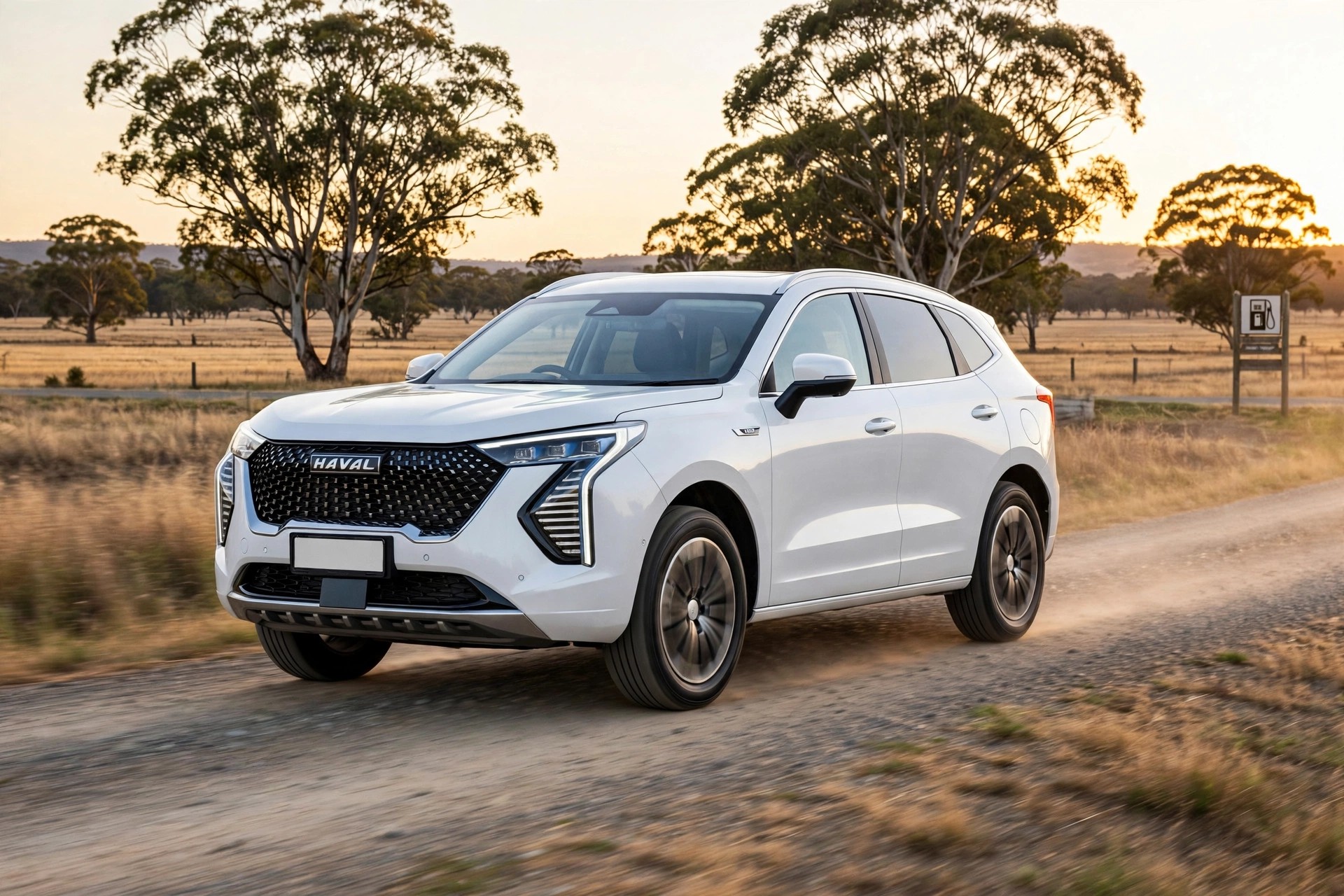

Quick answer: GWM’s brochure figure for the Haval Jolion Hybrid was 5.1L/100km combined for several years — but the current brochure (April 2026) lists 4.8L/100km. Either way, treat the brochure as a laboratory number (ADR 81/02). In Australia’s government-funded Real-World Testing Program, a 2025 Lux Hybrid tested on 3–4 March 2026 around Geelong, Victoria returned 6.5L/100km — 27% over its 5.1 lab figure. Independent media tests of the 5.1-spec cars range from 5.0 to 7.0L/100km depending on conditions. Budget around 6.5 for mixed driving on the older spec; no independent real-world test of the 4.8-spec cars has been published yet. Figures as of October 2026.
The numbers: claim vs. reality
| Source | Figure | Conditions |
|---|---|---|
| GWM brochure (2025 and earlier) | 5.1L/100km combined, 118g/km CO₂ | ADR 81/02 lab test |
| GWM brochure (April 2026) | 4.8L/100km combined, 111g/km CO₂ | ADR 81/02 lab test — no independent road test published yet |
| AAA Real-World Testing Program | 6.5L/100km (+27%) | 2025 Lux Hybrid, Geelong VIC, 3–4 Mar 2026 |
| Drive.com.au (Jan 2025, Ultra Hybrid) | 7.0L/100km | Mixed driving, “sensible” manner |
| Drive.com.au (Jul 2025, vs MG ZS Hybrid+) | 6.6 mixed; 6.3 urban loop | Urban loop: 70% over the 3.7L urban figure quoted |
| Chasing Cars (2024, Ultra Hybrid) | 6.5L/100km | 175km, brisk urban + frequent stop/start |
| CarExpert (Dec 2025, “2026 review”) | 5.0L/100km | Peak-hour commute, suburban + highway, no deliberate eco driving |
| Carscoops (via TopGear Ukraine) | 6.1L/100km | Road test of Australian 2025 Lux HEV |
| Owner report, ProductReview (Lmcl) | 7.2L/100km (personal best) | 2023 Ultra Hybrid, individual case |
The 3.7L/100km urban figure is listed on a dealer spec page rather than in GWM’s brochure itself. Test conditions differ across the table, so read each row on its own terms — the one directly comparable, standardised result is the AAA’s 6.5.
Why the gap exists
1. The brochure is a lab cycle, not your commute. The ADR 81/02 test includes a cold start, but it runs at controlled temperature, with no air-conditioning, no hills and gentle acceleration — a long way from daily driving. In the same AAA program the Jolion missed its lab figure by 27%, against +12% for the Toyota Yaris Cross Hybrid (4.5L/100km tested) and +10% for the C-HR Hybrid (4.4) — though the Hyundai Kona Hybrid missed by +33%, so the Jolion is not the worst offender. Its gap is simply wider than Toyota’s.
2. This hybrid’s sweet spot is the city. The powertrain pairs a small 1.5-litre naturally aspirated engine (70kW/125Nm) with a 115kW/250Nm electric motor — 140kW/375Nm combined through a two-speed dedicated hybrid transmission, hauling around 1,575kg per the April 2026 brochure (Drive’s two test cars weighed 1,595kg for the Lux and 1,620kg for the Ultra). Around town it leans on electric power and can run engine-off up to about 80km/h. At a steady 110km/h cruise, the little petrol engine does most of the work and the electric advantage fades. If your driving is mostly freeway, expect the upper half of the range.
3. Driving style moves the needle. Drive’s comparison test describes the behaviour precisely: both hybrids “usually [move] off from stopped on electric propulsion before the engine kicks in. A heavier foot brings the petrol engine in earlier too.” Short trips, cold starts and air-con on full blast are the worst combination, because the engine runs to warm itself and the cabin before the hybrid system can do its best work.
6 steps to narrow the gap
These are matched to the Jolion Hybrid’s actual hardware. How much each saves depends on your driving — no promises of a fixed number.
Step 1 — Use Eco for the commute. The four drive modes are Standard, Eco, Sport and Snow. Sport sharpens throttle response and brings the engine in earlier — useful for overtaking, not for economy. Leave it in Eco for daily driving.
Step 2 — Turn up regen in town; one-pedal is a road-test observation, not a manual-confirmed procedure. There are three levels of regenerative braking, and road tests (Drive, CarExpert) report a one-pedal mode that brought the car to a stop in crawling traffic without touching the brake pedal — rare for a hybrid. Treat this as a reviewer observation: it has not yet been matched against the Australian 2024–2026 owner manual for how it is enabled, exited, or how it behaves at a full stop, so do not rely on it as an operating instruction. Stronger regen recovers more in stop-start traffic; ease it off on the open road, where coasting is more efficient. When you need firm braking or a sure stop, use the brake pedal as normal.
Step 3 — Launch gently, lift off early. The car wants to move off on electric power — let it. Anticipate lights and lift off early so regen does the slowing instead of the brake pads.
Step 4 — Don’t judge the car by a highway run. Hybrids gain the least at steady high speed. A long freeway stint in the high 6s doesn’t mean anything is broken; it means physics. Compare tank-to-tank on your normal routine instead.
Step 5 — 91-octane is all it asks for. GWM’s brochure specifies 91 RON for every Jolion variant, hybrid included. Keep tyres at the placard pressure and take roof racks or bike carriers off when not in use.
Step 6 — Measure properly. Fill to the pump’s first automatic click and stop there — don’t keep topping up. Consumption = litres ÷ kilometres × 100, averaged over two or three tanks. Test results vary from 5.0 to 7.0 across different conditions, so a single short trip proves nothing.
What the gap costs
At 15,000km a year, the difference between 6.5 and 5.1L/100km is 210 litres — roughly A$378 a year at an assumed A$1.80/L for 91-octane (illustrative price; pump prices move). On range: the 55-litre tank gives a theoretical 846km at 6.5L/100km, versus ~1,078km at the brochure’s 5.1 — both are arithmetic, not promises.
Against its petrol siblings: the current brochure rates petrol Jolions at 6.5–6.7L/100km — also lab numbers, with no published real-world test. The only cross-reference available is the hybrid’s tested 7.0L/100km against the petrol version’s 7.5L/100km brochure claim — a tested figure versus a lab figure, not a like-for-like measurement. The data at hand cannot establish how the two compare in the same real-world driving, so no ranking or saving is stated here.
Three common mistakes
Idling to “warm up.” The hybrid warms up fastest being driven gently, not sitting in the driveway burning fuel for zero kilometres.
Living in Sport mode. Check which mode you’re actually in — Sport keeps the engine more readily in the loop, which works against economy.
Comparing a 3km winter school run with the lab figure. The ADR combined figure comes from a laboratory cycle (it includes a cold start, but at controlled temperature, no air-con, gentle acceleration). A 3km trip with the heater on full is nothing like that test.
When is a reading actually abnormal?
Seeing 6.5–7.0 on the dash lines up with the government test and multiple media tests. What deserves a look is consumption climbing persistently under similar driving conditions — check the usual suspects (tyre pressures, dragging brakes) rather than reading a verdict off one trip. Separately: a weak 12V auxiliary battery causes all sorts of electrical oddities on the Jolion Hybrid — we’ve collected the five questions owners ask about it here.
Applicability and sources
Applies to: Australian-market Haval Jolion Hybrid, 2024–2026 model years (1.5L naturally aspirated + dedicated hybrid transmission, 140kW/375Nm combined, kerb weight 1,575kg per the April 2026 brochure — Drive’s test cars: 1,595kg Lux, 1,620kg Ultra). Two brochure generations exist: 2025 and earlier list 5.1L/100km (118g/km); the April 2026 brochure lists 4.8L/100km (111g/km). The AAA 6.5L/100km result was measured on a 2025 Lux Hybrid and cannot be transferred to the 4.8-spec cars, for which no independent road test has been published.
Sources: GWM Australia brochures — earlier edition (5.1L/100km, 118g/km CO₂, 55L tank) and April 2026 edition (4.8L/100km, 111g/km; petrol 6.5–6.7; 91 RON) — figures verified in the PDFs; AAA Real-World Testing Program report (2025 Lux Hybrid, tested 3–4 March 2026, Geelong VIC: lab 5.1 → real-world 6.5L/100km, +27%) — verified in the report PDF; Drive.com.au 2025 Ultra Hybrid review (10 Jan 2025): 7.0L/100km mixed; Drive.com.au Jolion vs MG ZS Hybrid+ comparison (8 Jul 2025): 6.6 mixed, 6.3 urban loop; Chasing Cars 2024 review: 6.5 over 175km; CarExpert “2026” review (24 Dec 2025): 5.0 in peak-hour commuting; Carscoops Australian 2025 Lux HEV road test (via TopGear Ukraine): 6.1; ProductReview owner Lmcl (2023 Ultra Hybrid): personal best 7.2; dealer spec page listing the 3.7L/100km urban figure; rival-program comparisons (Yaris Cross, C-HR, Kona) via RACV’s summary of the same program. Technical behaviour (electric launch, engine engagement, regen levels, one-pedal mode, ~80km/h EV running) per Drive and CarExpert road tests; cost arithmetic independently recalculated with assumptions stated.
More Jolion guides: Haval Jolion “Key Not Detected”: checks, emergency start & CR2032 fix