
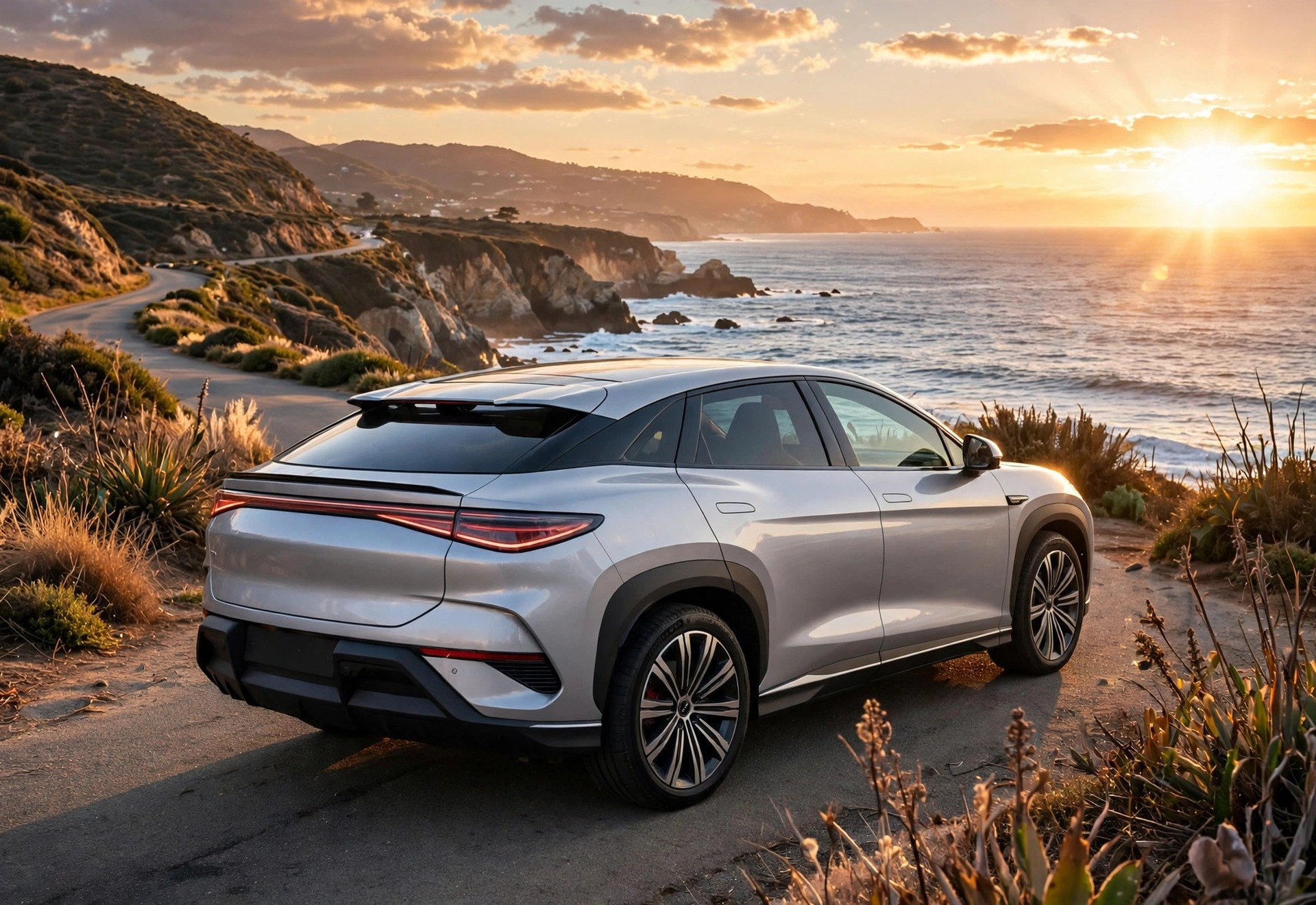

Yes, a BYD Sealion 7 can cross the Nullarbor between Perth and Adelaide — on paper, comfortably. The arithmetic: the car's 82.56 kWh battery (nominal capacity; usable capacity unverified — the estimates below assume this figure) delivers roughly 360–380 km of real highway range (forget the 482 km WLTP figure for this trip), and the longest gap between charger locations on the Eyre Highway is 191 km (Norseman to Balladonia). In practice, plan for the chargers, not the distance: headwinds and faulty chargers eat that margin fast. This guide gives you a station-by-station plan for the 1,206 km Norseman–Ceduna core — the stretch with the longest charger gaps. The Perth–Norseman and Ceduna–Adelaide bookends have denser charger coverage; plan those legs on PlugShare using the same buffer rules in this guide.
The Sealion 7 numbers for this trip
Start with what the car can actually do, from BYD Australia's official spec sheet and independent tests — not the brochure headline. All range figures below are for the Premium RWD; the Performance AWD (WLTP 456 km) will return less.
Range. The official WLTP figure is 482 km for the Premium (BYD Australia spec sheet v3). In chasingcars' 2026 review, a highway test averaging about 100 km/h returned 21.5 kWh/100 km — roughly 383 km of range. The Driven's review estimated around 360 km from roughly 23 kWh/100 km at highway speed. A 30,000 km owner long-term test averaged 18.1 kWh/100 km in mixed driving, but saw 30 kWh/100 km on a hilly, windy day at 110 km/h (EV Central owner review). Plan on 360–380 km of highway range for the Premium in calm conditions, and less with a headwind.
Charging. The spec sheet confirms a 150 kW peak DC rate (CCS2) and 11 kW three-phase onboard AC (Type 2). BYD claims 10–80% in about 32 minutes — chasingcars notes this as a manufacturer figure, not a measured one. More important for this route: many Nullarbor chargers are 50 kW or slower. At a 150 kW-class charger a 20–80% session is roughly half an hour; at a 22 kW DC community charger the same ~50 kWh takes over two hours (about 2h15m in ideal conditions, before charging-curve taper and losses) — and that is DC; on AC the car is limited by its 11 kW onboard charger. Plan each stop around the charger's rated power, not the car's peak.
What comes in the car. The spec sheet confirms a portable Mode 2 charging cable is included — that is your granny-charger backup, pack it. It also confirms the car ships with only a tyre repair kit, no spare wheel. That detail matters on the Nullarbor more than anywhere else in Australia (more below).
The 2026 reality check: the chargers exist, but don't bet on them
Two narratives are circulating about the Nullarbor in 2026. EV Evolution's January 2026 update says the infamous charging black holes are a thing of the past. But The Driven's June 2026 investigation found off-grid stations capped at 30 kW shared between two cars, Mundrabilla's charger limited to 11 kW AC after it kept blacking out the roadhouse, Norseman's DC charger out of order for 13 weeks — and the NRMA solar unit at Border Village destroyed by a truck. The Tesla Owners Club of WA's crossing guide (updated May 2026 by people who have crossed 12 times) warns station by station not to trust the chargers.
The honest version: the hardware is largely in place, but 2026 reliability is patchy. Plan the trip as if any single charger might be down, and you will have a good trip. That is what the rest of this guide does.
Station-by-station plan: Norseman to Ceduna (west to east)
Distances are road kilometres between roadhouses, per Nullarbor Net's distance table (updated September 2026); total Norseman–Ceduna is 1,206 km. Station statuses mix the TOCWA guide (May 2026) and The Driven's reporting (June 2026) — where they conflict, both are noted with dates. Charge estimates assume ~22 kWh/100 km in calm conditions, giving roughly 225 km of travel per 20–80% charge (49.5 kWh). In a headwind or at 110 km/h, owners have reported 30 kWh/100 km — at that rate the same 20–80% covers only about 165 km, which turns the 191 km Norseman→Balladonia leg from comfortable to marginal. Treat every percentage below as a calm-weather estimate, not a promise: when the wind is up, add one extra charging stop (or 15–20% more charge) per leg.
| Leg | Distance | Charging at the stop | Est. arrival | Departure target |
|---|---|---|---|---|
| Norseman → Balladonia | 191 km | The longest leg — about 51% of the battery. Norseman has a WA EV Network 150 kW DC, but The Driven reported it out of order for 13 weeks as of June 2026. Check its PlugShare status the night before; if it is down, find AC charging in town or wait — do not start this leg without a near-full battery — in a strong headwind this leg needs roughly 58 kWh, so near-full is mandatory, not optional. | ~49% | Near 100% |
| Balladonia → Caiguna | 182 km | WAEV 50 kW plus a community-funded 22 kW DC (key from reception) — two options listed; check current status of both. This leg includes the famous 90-mile straight. | ~31% | 80% |
| Caiguna → Cocklebiddy | 64 km | WAEV 50 kW, reported limited to ~30 kW in practice (The Driven, June 2026). Short hop; a quick top-up is enough. | ~43% | 60% |
| Cocklebiddy → Madura | 91 km | Community 22 kW DC (~$25 a session) — get the key from the front desk before they close, and expect to leave ID as deposit. | ~46% | 70% |
| Madura → Mundrabilla | 115 km | WAEV 50 kW (24/7; on free vend as of mid-2026, slated to move to $0.60/kWh on Chargefox per TOCWA May 2026) plus a community 22 kW in the garage — note the garage closes at 5 pm. | ~49% | 80% |
| Mundrabilla → Border Village | 78 km | The black spot. The Horizon 50 kW regularly blacks out the roadhouse, so the owner limits it to 11 kW AC (The Driven, June 2026). The working option is the temporary canola-oil Biofil 50 kW at the rear of the property, installed late May 2026 — free, and not on Chargefox. Eucla (66 km) no longer offers EV charging at all, so plan Mundrabilla→Border Village as one combined 78 km leg with buffer. | ~49% | 70% |
| Border Village → Nullarbor Roadhouse | 186 km | TOCWA (May 2026) lists NRMA 2×80 kW here — but The Driven (June 2026) reports the solar unit was destroyed by a truck. Treat this site as out until PlugShare confirms otherwise. Backup per TOCWA: the roadhouse workshop offers 20 A three-phase charging (ask for Trevor at reception, complimentary) — slow, but a genuine Plan B. If Border Village is out, Mundrabilla→Nullarbor Roadhouse becomes a ~264 km combined stretch: leave Mundrabilla near 100% and only in calm conditions. | ~35% | 85% |
| Nullarbor Roadhouse → Yalata | 94 km | NRMA 2×75 kW solar+battery off-grid, plus a community 22 kW. Flaky — monitor the session and be ready to unplug and restart. There is also a three-phase outlet behind the main building (~$30 via the cafeteria, per TOCWA): this is where the Sealion 7's 11 kW onboard AC earns its keep. | ~50% | 75% |
| Yalata → Nundroo | 52 km | Yalata: RAA 50 kW limited to ~35 kW. TOCWA says do not skip it heading west — the Nullarbor charger can't be trusted. Short hop. | ~51% | 65% |
| Nundroo → Penong | 76 km | Nundroo: NRMA 180 kW eLumina (installed May 2026, per TOCWA) — the strongest charger on the eastern half. | ~55% | 75% |
| Penong → Ceduna | 77 km | Penong caravan park has a 32 A three-phase outlet as backup (per TOCWA); Ceduna has RAA DC. | ~34% at Ceduna | — (pass through; top up only if needed) |
Driving east to west, reverse the plan. The arithmetic works the same way — only the wind direction changes, and wind matters more than direction.
Before you leave: the checklist
Apps and cards. PlugShare is the most useful user-reported source — read the comments and recent check-ins at every stop, and check in yourself every time you charge so oncoming drivers can plan around you. But cross-check: no single app's "available" status is gospel, and NRMA's app has been known not to show when a site is down (The Driven). Also install Chargefox, the NRMA app and the Tesla app, and carry a Chargefox RFID card: internet in the bush is erratic and a physical card still works when the app won't load. One caution from a detailed driver report: in 24 Chargefox sessions, 12 delivered at least 25% less than the claimed kW (The Driven) — don't trust time estimates from apps blindly.
Cables. Pack your Type 2 cable and the included Mode 2 granny cable. TOCWA's advice for the Nullarbor: a 32 A three-phase portable charger (e.g. Juice Booster 2 or KHONS) is the correct Plan B and C. Their mantra is worth memorising: always be charging — never cut a session short at a working charger because you think the next one is faster or cheaper.
Tyres. This is the Sealion 7-specific item: the car ships with a tyre repair kit only. TOCWA is blunt — bring a full-size spare wheel and tyre combo (The Driven's crossing guide suggests a space-saver at minimum). Roadhouses sell fuel, food and drink; they do not change tyres, and a Nullarbor tyre failure is a major one, not a slow leak. Check cold pressures before departure and monitor them through the trip.
Comms and weather. Telstra has the only usable coverage — but check each carrier’s official coverage map before you set off; note that Boost uses the full Telstra network, so resellers can’t be written off entirely; enable Wi-Fi calling, and a Starlink Mini with roaming is the gold standard. Install the BOM app — air temperature and wind direction directly change your range, so check the forecast before each leg and add more charge than you think you need. One Nullarbor quirk: the plain runs its own timezone (AWCT) between Cocklebiddy and the WA border — arrive at a roadhouse by your watch's time and you may find it closed.
Timing. Drive in daylight. Kangaroos make night driving a genuine hazard; experienced crossers leave just before sunrise and park up at least two hours before sunset. On short winter days about 650 km is a sensible daily target; on long summer days up to 900 km is possible.
Common problems and how to handle them
Headwind. Expect about 20% less range than at the same speed on a Sydney–Melbourne type road — plan charging stops on Nullarbor range, not your normal interstate range (The Driven). In a strong headwind, waiting is a legitimate strategy: electric motorbike rider Ed Darmanin delayed two days at Esperance waiting out a 30–45 km/h headwind during his 2026 lap of Australia (CleanTechnica). A car has more buffer than a bike, but check the wind before each leg all the same; in moderate wind, slowing to 95 km/h is the practical compromise.
A charger is down or derated. This is the expected case, not the exception. Fall back to the community 22 kW units (keys from reception, mind the hours), the three-phase outlets, or the Biofil unit at Mundrabilla. At NRMA stations that misbehave, unplugging and restarting the session sometimes helps — and watch the session rather than walking away.
The range number lies to you. BYD's headline range figure is an estimate, not a prediction. On the 2023 crossing by "Atto Gal" in a BYD Atto 3, the trip computer gave no real-time remaining-range prediction — every leg had to be planned by distance and energy, not by the number on the dash (The Driven). Do the same in the Sealion 7: plan each leg in kilometres and kWh, keep a 30 km buffer, and ignore the optimistic number.
Heat. EV Evolution notes charging speeds can throttle back in 40°C+ heat to protect the battery. Park in shade while charging if you can.
What it costs (estimate)
For the ~1,206 km Norseman–Ceduna core at 22 kWh/100 km, the car needs roughly 265 kWh. Much of the WA EV Network was still on free vend in mid-2026; paid stops vary wildly — about $0.60/kWh at Madura once it joins Chargefox, ~$25 flat sessions at community 22 kW chargers, up to $3.00/kWh at some roadhouse units. As a rough bracket: expect roughly AU$60–180 for the core crossing, depending on how much free-vend charging you catch. For reference, The Driven's 2024 full Perth–Adelaide run cost $140.20 in charging for a Model Y against $154.56 of diesel for a Tucson — 2024 prices, but the shape of the answer hasn't changed.
The bottom line
The Sealion 7 has the range for every leg of the Nullarbor — the longest gap is 191 km against ~360–380 km of real highway range. What it doesn't have is a guarantee that any given charger will work when you arrive. Cross with that assumption: leave the gateways near full, charge at every working station, carry the cables and the spare wheel, check PlugShare at every stop, and respect the wind. Do that, and the crossing is a long drive with good coffee stops — not a gamble.
Sources: BYD Sealion 7 official spec sheet v3 (BYD Australia); TOCWA Nullarbor crossing guide (updated May 2026); The Driven — Nullarbor charger reliability investigation (June 2026); The Driven — Nullarbor must-dos and Plan B (April 2026); EV Evolution — 2026 regional charging update; Dreaming of Down Under — Nullarbor roadhouses; Nullarbor Net — fuel stops and distances (Sept 2026); The Driven — Perth–Adelaide charging vs diesel cost (2024); owner experience via EV Central 30,000 km owner review.
Related reading:
- BYD Shark 6 Towing in Australia: Real-World Guide — another long-haul Australian BYD guide, this time with a trailer.
- BYD Dolphin: How to Turn Off Driver Assistance Warnings — same BYD family, Australian roads.



[…] a long hot-weather drive? Our Nullarbor charging guide covers station-by-station planning for Australia’s most heat-exposed EV route. For more on […]