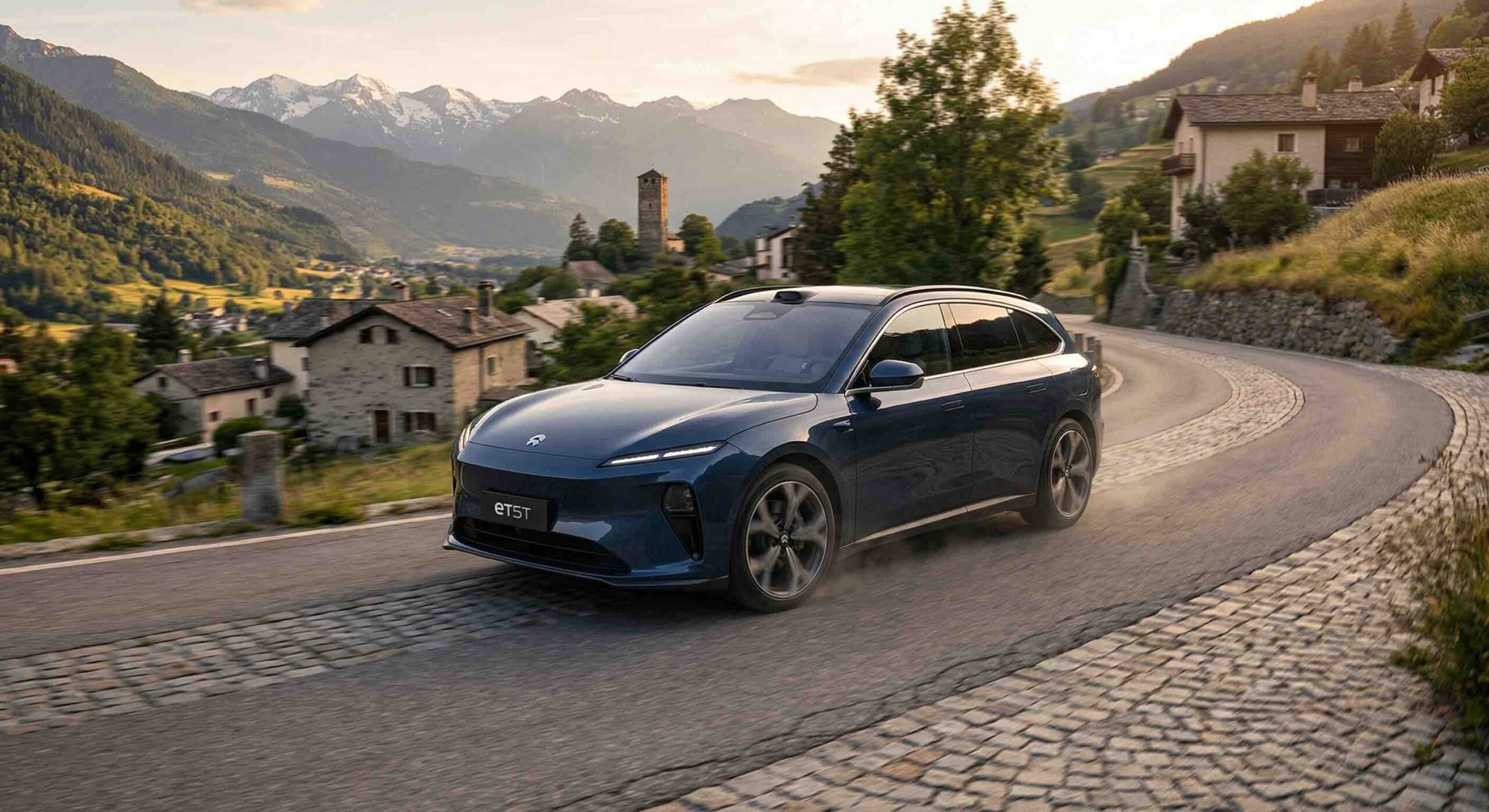

A Conversation About the Soul of the Wagon
On a winter morning somewhere on Norway’s Scandinavian Peninsula, the temperature was minus 15 degrees Celsius. An Audi A4 Avant was steadily climbing a winding mountain road, its quattro all-wheel-drive system distributing torque precisely to each wheel. The driver was an outdoor enthusiast, with the trunk stuffed full of ski gear. This was the classic scene of European wagon culture over the past twenty years: a German wagon, a freedom-loving owner, a journey toward the snowy mountains.
Now, the same scene is being rewritten. A Nio ET5T pulls into a battery swap station outside Oslo, and 3 minutes and 20 seconds later, it sets off with a full charge. It carries the same skiers’ dreams and faces the same winding mountain roads — but its power source, its refueling method, even its driving feel are entirely different from those of a traditional wagon.
This is not just a product-level substitution. It is a deeper conversation about the “soul of the wagon.” As the wave of electrification sweeps across the European continent and battery swap stations take root in the Nordic wilderness, can the Nio ET5T truly shake the Audi A4 Avant’s place in wagon lovers’ hearts? The answer is far more complex than a spec sheet.
Design Philosophy: When the “Shooting Brake” Meets Electrification
Before talking about driving, we must talk about design — because for wagon buyers, looks are often the first hurdle.
The Nio ET5T’s design language can be traced back to the ET5 sedan. A long hood, a fastback roofline, a short and muscular rear — these elements combine to form a unique stance between a sedan and a wagon. Nio officially positions it as a “smart electric wagon,” but in design circles, more people are willing to call it a “shooting brake.”
The shooting brake concept comes from the British aristocracy. In the early 20th century, gentlemen needed a car that could be driven daily yet also carry hunting equipment. So the shooting brake — built on two-door sports cars — was born. This body style carries a dual DNA of elegance and practicality: it had to look like a sports car while swallowing hunting rifles and hounds.
The ET5T inherits exactly this duality. Viewed from the side, the roofline behind the C-pillar does not drop vertically like a traditional wagon but forms an elegant arc. This design sacrifices some trunk height but delivers a highly distinctive silhouette. In an Autohome owner survey, over 70% of ET5T owners said “exterior design” was the top factor in their purchase decision.
The 2025 ET5T received subtle but precise exterior adjustments. The front fascia gained layered lines on both sides, making the lower half of the car look tougher; the rear bumper gained a diffuser design that not only optimizes aerodynamics but also gives the rear a sportier feel. These changes are restrained, but anyone who knows cars can spot the difference at a glance.
Compared with the Audi A4 Avant, the two have entirely different design philosophies. The A4 Avant pursues the “standard answer”: a three-box sedan base with a raised roof and extended D-pillar, forming a square, boxy trunk space. This design is the most practical, but also the most mundane. In the German luxury brand lineup, the Avant is the pragmatic choice, not the individual one.
The ET5T goes the opposite way. It uses the shooting brake stance to tell consumers: a wagon can also be a carrier of design, not just a compromise of space. This positioning works especially well in the European market — when the streets are full of A4 Avants and 3 Series Tourings, an ET5T genuinely makes people take a second look.
British automotive media Autocar wrote in its review: “The ET5 has none of those cheap or odd Chinese brand impressions; its design is mainstream enough while having its own style. The name ‘Nio ET5’ is not sexy, but it is inoffensive, and it passes the ‘golf club test’ of mainstream European society.”
This review sounds mild but is actually an extremely high recognition of a Chinese brand. In the past, many Chinese EVs were either too exaggerated in design or full of copycat traces. The ET5T’s design level can already compete on the same stage as first-tier European brands.
Driving Feel: From “Rock Hard” to “Gentle yet Precise”
If design is the ET5T’s first hurdle, then driving feel is the core factor determining whether it can truly win the European market.
The 2024 ET5T received quite a few criticisms over chassis tuning. As the first electric wagon from a Chinese brand attempting a sporty positioning, Nio chose an aggressive suspension setup on the first-generation ET5/ET5T — hard, very hard, extremely hard. This setup might bring fun on a track, but in daily commuting and long-distance travel it became a nightmare.
One ET5T owner complained on social media: “Going over a speed bump, my whole body bounced up like I was being launched. Passengers in the back always asked me if I forgot to slow down.” This feedback was not an isolated case. In Autohome’s owner forums, complaints about “suspension too stiff” were endless.
Nio heard these voices. The 2025 ET5T made a key decision: standard CDC continuously variable damping suspension across the lineup.
CDC (Continuous Damping Control) technology is not new, but it is quite rare among Chinese brands at the 300,000-yuan price point. The system can adjust the shock absorbers’ damping in real time according to road conditions, theoretically balancing comfort and sportiness.
More importantly, Nio introduced the all-new EP Mode (Enhanced Performance Mode), allowing drivers to independently adjust front and rear axle suspension damping across 11 levels. This means you can make the front suspension softer to absorb road impacts while keeping the rear firmer to maintain cornering stability.
In real-world experience, the system’s performance is quite impressive. The New Travel review team wrote in their mountain road test: “With the suspension set to its softest, the car irons out road unevenness and small vibrations one by one. Note: ‘irons out’ rather than ‘dissolves’ — because even at its softest, the ET5T’s overall character is still sporty, never reaching the floating feel of the ES6.”
This description is very accurate. The ET5T is still fundamentally a car that pursues driving fun; its “comfort” is relative. But compared with the previous generation’s rock-hard feel, the new model has made a qualitative leap.
In terms of handling, the ET5T is equally impressive. The dual-motor all-wheel-drive system delivers 480 horsepower, with 0–100 km/h acceleration in just 4 seconds. But more commendable are its linear steering feedback and precise cornering posture.
The New Travel review team added: “On various winding roads and mountain passes, you can clearly feel the suspension holding the body tightly, giving you great driving confidence. With the suspension set to its hardest, the car’s road-hugging feel and traceability reach class-leading levels.”
So, compared with the Audi A4 Avant, where does the ET5T’s driving feel stand?
On chassis fundamentals alone, the A4 Avant remains the benchmark. Audi’s decades of chassis tuning experience are deposited in every detail: the compression-rebound rhythm of the suspension, the assist gain of the steering, the body roll suppression — all forming a textbook expression of “German driving feel.” Even entry-level 40 TFSI models deliver a solid, stable, predictable driving experience.
The ET5T presents a different style. Thanks to the battery pack’s weight distribution, EVs have a naturally lower center of gravity, which provides extra stability in corners. But battery weight also brings new challenges — how to control body inertia while ensuring comfort? The CDC suspension gives the answer: use variable damping to handle different conditions, use precise tuning to balance comfort and sportiness.
In an Autohome review video, the host gave an interesting evaluation: “I even dared to tell a product manager to his face at the Zeekr 007GT test drive: the ET5T is still better looking than your car. After the facelift, the ET5T is undoubtedly the top choice among electric wagons. And thanks to battery swapping, it can genuinely travel!”
“Genuinely travel” — this phrase captures the ET5T’s core advantage over other electric wagons.
Battery Swap Network: Making the “Electric Wagon” Live Up to Its Name
The electric wagon is a contradictory existence. Wagons are born for long-distance travel, while EV range anxiety is precisely the biggest obstacle to long-distance travel. This is not a problem unique to Nio; it is a challenge every electric brand trying to enter the wagon market must face.
Tesla’s solution is the Supercharger network. V3 Superchargers can add 250 km of range in 15 minutes — but users still have to wait at the charging station. For fuel-car owners used to “3 minutes to fill up” at gas stations, a 15-minute wait remains a compromise.
Nio’s solution is more radical: battery swapping.
The ET5T can complete a battery swap in 3–4 minutes at any Nio battery swap station, without even getting out of the car. This refueling speed is already close to the gas station experience, making the “electric wagon” positioning truly stand on its feet.
More importantly, Nio is actively expanding its swap network in Europe. By the end of 2025, Nio had built over 30 third-generation battery swap stations in Europe, covering Denmark, Germany, Norway, the Netherlands, Sweden, and other countries. This number is still growing rapidly.
For ski and road-trip enthusiasts, the value of the swap network is particularly prominent.
Imagine a typical Nordic ski trip: depart from Oslo, drive 3 hours to the Trysil ski resort, crossing mountains and forests along the way. In the fuel-car era, gas stations along this route were plentiful. But in the EV era, charging infrastructure coverage is still a problem — especially in remote mountain areas.
Nio’s strategy is to place swap stations at key nodes. For example, setting up a swap station on the road from Oslo to Trysil lets ski enthusiasts quickly recharge before departure or on the return trip. This “nodal coverage” is not as dense as in cities, but it is enough for long-distance travel.
A Norwegian Nio owner shared his experience on Reddit: “Last week I drove from Oslo to Bergen, 560 km in total, with one battery swap in the middle. The whole process was very smooth — much more convenient than I imagined. I used to have range anxiety driving long distances in an EV, but battery swapping completely changed that experience.”
Of course, the swap model has its limitations. First is coverage: the number of swap stations in Europe is still far below that of charging piles, meaning ET5T owners in some regions still need to rely on public charging networks. Second is cost: building and operating swap stations costs far more than ordinary charging piles, which may affect Nio’s profitability.
But regardless, battery swap technology gives the ET5T a unique competitive advantage. In today’s increasingly homogenized EV market, brands that can differentiate on the refueling experience are few and far between. Nio is one of them.
Intelligent Driving: Boosted by the Shenji Chip
Another major upgrade of the 2025 ET5T is the switch to Nio’s self-developed Shenji chip (NX9031).
This is an important milestone for China’s automotive industry. For a long time, intelligent driving chips were monopolized by foreign suppliers such as Mobileye, NVIDIA, and Qualcomm. Mass production of Nio’s Shenji chip marks Chinese brands beginning to achieve self-sufficiency in this core domain.
The Shenji chip uses a 7nm process, with a single chip delivering 1016 TOPS — exceeding NVIDIA Orin-X’s 254 TOPS. The ET5T carries two Shenji chips, with total computing power exceeding 2000 TOPS, providing ample reserves for high-level intelligent driving.
In real-world experience, the new generation NOP+ (Navigate on Pilot+) shows clear improvement. The New Travel review team noted: “From traffic efficiency to lane-selection logic to detour speed, everything has improved enormously. Especially in the transition scenarios between city roads and highways, the system performs more naturally and smoothly.”
But the maturity of intelligent driving remains a controversial topic. In a Sohu Auto intelligent-driving test, the ET5T failed to issue timely collision warnings in foggy conditions, and also showed recognition problems in heavy rain combined with nighttime backlight. These scenarios show that even with powerful hardware, software algorithms still need time to mature.
Compared with the Audi A4 Avant, the latter takes a conservative route on driver assistance. Audi’s driver assistance systems are known for stability, but offer few flashy highlights in functionality. For users who pursue the traditional driving experience, this “good enough” strategy is actually an advantage.
The ET5T represents the aggressive attitude of Chinese brands toward intelligent driving: maxed-out hardware, features first, continuous iteration through OTA. This strategy carries risks — users may experience immature features in early versions. But it also has payoffs: as algorithms mature, users enjoy a continuously upgrading experience.
Space and Practicality: A Wagon’s Fundamentals
A wagon must be able to carry things. This is the survival rule of this category.
The ET5T’s trunk capacity is 450 liters, expandable to over 1000 liters with the rear seats folded. This figure is on par with the Audi A4 Avant, easily accommodating skis, golf bags, or camping gear.
But in space utilization, the ET5T faces a problem unique to EVs: rear wheel-arch intrusion into the cabin. Due to the layout of the rear motor and electronic control systems, the ET5T’s rear middle floor is raised quite high, affecting the fifth passenger’s comfort.
The 2025 ET5T made significant improvements in seat comfort. Longer cushions, softer padding, better support. CarNewsChina’s review noted: “Tall drivers rejoice: longer, more supportive cushions, thigh support reaching the level of European sport wagons. Nio added 14-way seat adjustment and upgraded the foam filling to improve posture and long-distance comfort.”
On the interior front, the ET5T adopts the “second living room” design philosophy. The 2025 model changed the center screen from vertical to horizontal, reducing visual fragmentation; added a HUD head-up display, reducing the frequency of looking down at navigation; the NOMI voice assistant’s interactions are also more natural.
Overall, the ET5T meets the basic requirements of a wagon in space and practicality, though it does not pursue extreme loading capacity like some brands. Its positioning leans more toward a “good-looking and practical sports wagon” rather than a “moving tool that swallows everything.”
Price and Value: What Can 300,000 Yuan Buy?
The 2025 ET5T starts at 298,000 yuan (about USD 42,000). This price would be slightly higher in the European market, but still lower than German competitors in the same class.
Take the Audi A4 Avant as an example: in the European market it starts at about EUR 48,000 (about USD 52,000). Opting for the higher-output 45 TFSI quattro version pushes the price above EUR 55,000.
The ET5T offers a “leapfrog” pricing strategy: 300,000-yuan pricing delivering 500,000-yuan-level performance and configuration. 480 horsepower dual-motor AWD, CDC suspension, intelligent driving, battery swap service — these features combined might require tens of thousands of yuan in extra options on a German brand.
More importantly, Nio offers flexible purchase plans. Users can choose the BaaS (Battery as a Service) model — buying the car body and battery separately. The body price drops by about 70,000 yuan, with a monthly battery rental fee. This model lowers the purchase threshold and also resolves battery degradation concerns.
But price advantage is only one side of the coin. The other side is brand perception and resale value.
In the European market, Audi has over 50 years of brand accumulation; the A4 Avant has long been synonymous with the wagon category. Buying an A4 Avant is, to some extent, buying a “mature and reliable” brand endorsement.
Nio is a new face in the European market. Although it has established certain brand recognition in China, European consumers still harbor doubts about Nio: can after-sales service be guaranteed? Is the parts supply stable? Can the brand operate long-term? These questions have no standard answers and need time to verify.
The European Market: Opportunities and Challenges Coexist
2025 was a key year for Nio’s European strategy. This year, the ET5T completed its mid-cycle facelift, the swap network expanded rapidly, and the brand began to make its mark in mainstream markets.
But the European market has never been easy land to till.
First is the policy environment. The EU imposed provisional tariffs on Chinese EVs, raising Nio’s operating costs in Europe. Although Nio could avoid tariffs by building factories in Europe, that would require huge investment and long cycles.
Second is the competitive landscape. Tesla Model 3/Y have already dominated the European EV market, and local brands like Volkswagen, BMW, and Mercedes-Benz are also accelerating their electrification. In the wagon segment, the Volkswagen ID.7 Tourer and BMW i5 Touring are the ET5T’s direct competitors.
Third is user preference. European consumers demand near-picky vehicle quality, and building trust in new brands takes time. A German journalist shared his long-term ET5 test experience: “I drove from Germany to Denmark, 560 miles in total. The car was very quiet, very comfortable. But the frequent warnings and alert sounds from the autonomous driving features annoyed me — tolerable on short trips, but imagine listening to these noises for several hours straight.”
This feedback is very real. European consumers need more than product parameters; they care more about the overall experience’s completeness. This is where Nio needs to keep improving.
In Closing: The Future of the Wagon — Who Is the Answer?
Back to the original question: is the ET5T really good to drive?
The answer depends on your definition of “good to drive.”
If you pursue pure driving pleasure, the Audi A4 Avant remains the more mature choice. The quattro AWD system’s tuning is nearly perfect, and the chassis quality is the crystallization of decades of technical accumulation. Driving an A4 Avant, you can feel German engineers’ understanding of and respect for “driving.”
But if you are willing to embrace change, the ET5T offers a completely new answer.
480 horsepower in reserve makes every overtake effortless; the CDC suspension makes daily commuting no longer a torment; the growing swap network makes long-distance travel worry-free; the Shenji chip gives intelligent driving infinite possibilities.
More importantly, the ET5T represents a direction for the automotive industry: electrification is not just replacing the engine with a motor, but redefining the car’s value proposition. The wagon is no longer just a “sedan that can hold a lot of luggage” but an intelligent, efficient, sustainable travel companion.
At a Norwegian swap station, an ET5T owner just finished swapping and drives toward the snowy mountains. He used to own an A4 Avant; now he is a fan of the electric wagon.
“Battery swapping changed my travel habits,” he said. “I used to calculate fuel consumption for every kilometer; now I just need to plan where the swap stations are. It feels like switching from a flip phone to a smartphone — awkward at first, but there’s no going back.”
This may be the ET5T’s greatest value: it is not just a replacement for the Audi A4 Avant, but an evolutionary attempt for the wagon category. Whether it succeeds or not, this attempt itself deserves respect.
A new chapter in the European wagon market is being written. And the ET5T is already standing at the desk.