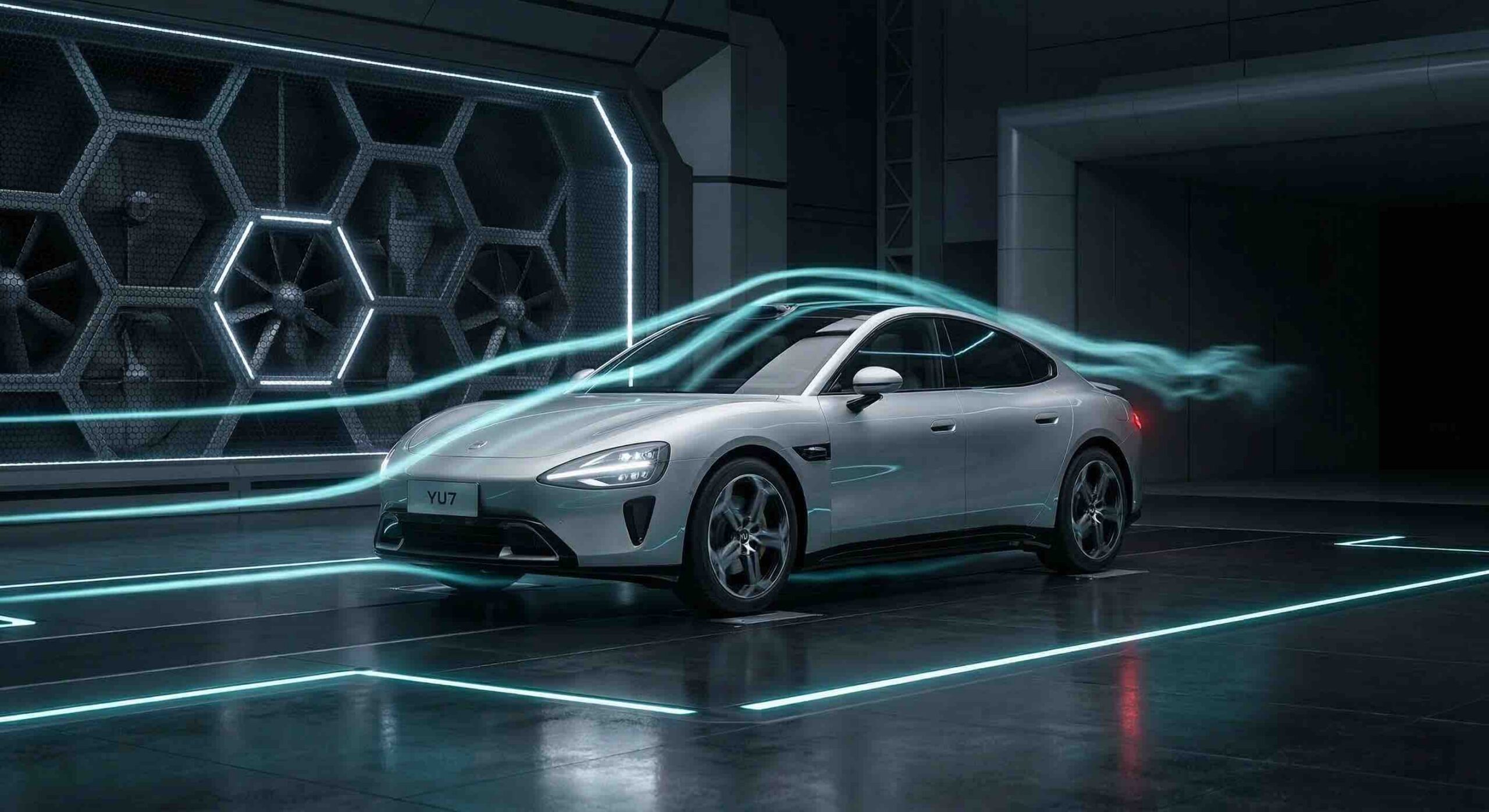

The SUV has a born-with physical curse: a tall body, a large frontal area, high ground clearance — the very traits that make it dominant in space and practicality are an aerodynamicist’s nightmare.
So when I saw that the Xiaomi YU7’s CLTC range was 835 km, my first reaction was: how did they do it?
A mid-to-large pure electric SUV, weighing over 2,400 kg curb — how low can its drag coefficient go? The Tesla Model Y is at 0.23 Cd, already the industry benchmark. Xiaomi says their active grille shutters, when fully closed, can shave another 18 counts (0.018).
This isn’t a simple spec race. It’s an engineering breakthrough about making an SUV not look like an SUV.
100 Vanes: A Precise Surgery on the Air
Open up the YU7’s front face and you’ll see densely packed grille vanes. Count them — exactly 100.
What’s the concept? Most EVs’ active grilles only have 20-40 vanes. Why does Xiaomi need so many?
The answer: fine-grained control.
Traditional few-vane grilles are either all-open or all-closed. But aerodynamics is not black and white — different operating conditions need different amounts of intake air. 100 vanes can be controlled independently in angle, precisely regulating intake air like a camera aperture. Fully closed during high-speed cruising to form a smooth surface; at cold start or high load, only the needed portion opens.
Xiaomi’s engineering team told me that with all 100 vanes fully closed, the drag coefficient drops by 18 counts. Converted to range, that’s about 14 km. Doesn’t sound like much, but for an SUV over 2.4 tonnes, every count is the result of repeated calculation.
The Drag War Hidden in the Details
Active grille shutters are the most visible design, but drag optimization is an everywhere war.
The door handles are flush — fully retracted into the doors while driving, eliminating airflow disturbance from protrusions. Real-world measurements show this small detail alone can lower the drag coefficient by about 0.002-0.003. Sounds negligible, but in the world of drag optimization, this is every bit counts.
The underbody is fully enclosed. Battery pack, motors, suspension components are all wrapped by protective plates, forming smooth airflow channels. Air flows at high speed under the car, reducing turbulence and lift. The price of this solution is higher cost and lower serviceability, but its contribution to range and high-speed stability is real.
The tail is equipped with a complex rear diffuser. Its job is to accelerate the evacuation of underbody airflow, forming a suction effect behind the car and reducing the low-pressure zone at the tail. This design is especially noticeable at high speed — you won’t feel the tail being pulled, but being pushed.
245mm Tires: A Choice About Trade-offs
Xiaomi SU7 comes standard with 245mm-wide tires, high trims use 265mm or even wider. But the YU7 Standard also uses 245mm tire width, and the official explanation is prioritize range.
This choice surprised me a bit. A mid-to-large SUV — shouldn’t it use wider tires to guarantee grip?
But on second thought, this trade-off is the right one.
Wider tires mean greater rolling resistance and greater drag. For a family SUV whose core selling point is range, 245mm is enough — daily commuting doesn’t need track-level grip, but every extra millimeter of tire width is real electricity consumption.
Of course, Xiaomi also offers options: 21-inch wheels with 275mm rear tires. If you’re a handling-seeking user, you can pay extra to upgrade. This standard is enough, options satisfy strategy shows Xiaomi’s granular grasp of different user needs.
835 km: The Engineering Trade-offs Behind the Number
The YU7 rear-drive version carries a 96.3kWh battery with 835 km CLTC range. This is the range ceiling for mid-to-large pure electric SUVs.
But CLTC is just a reference. What’s the real world like?
Multiple measured data: MIIT energy consumption 13.3kWh/100km; media test (Yiche) 12.3kWh/100km; owner mixed-road composite 16.8kWh/100km; aggressive driving (Ai Fan Er test) 24.0kWh/100km.
The core of the difference is operating conditions. The CLTC cycle is relatively gentle, while real driving includes air conditioning, audio, traffic jams, hard acceleration and other scenarios. For a high-performance SUV, comprehensive consumption around 20kWh/100km is a normal level.
The good news is the 800V platform brings extremely fast charging speed. 15 minutes to replenish 300 km, effectively alleviating range anxiety. The bad news is there still aren’t enough charging piles that can feed this speed.
Vs. Model Y: Where Does Xiaomi Win?
Lei Jun put the YU7 and Model Y side by side at the launch event for item-by-item comparison. This isn’t a marketing gimmick — it’s clear product positioning: directly benchmarking the global sales champion.
YU7 rear-drive 253,500 yuan, Model Y rear-drive 263,500 yuan. Similar price, but what more does the YU7 have?
Much bigger battery (96.3kWh vs 62.5kWh), much longer range (835km vs 590km), plus LiDAR and air suspension — configurations the Model Y doesn’t have.
Lei Jun said: Just looking at the configuration, it’s worth 60,000-70,000 more than the Model Y. That’s clever phrasing — the YU7 is priced lower, but its configuration is a whole tier higher.
In October 2025, YU7 sold 33,662 units, surpassing the Model Y’s sales in the Chinese market during the same period. This number proves that Xiaomi’s configuration + ecosystem combination punch really works in the Chinese market.
Shortcomings: An Imperfect Family Companion
The YU7 is not a perfect car.
Rear seats only support heating, not ventilation. Seatback angle is on the upright side, long-distance seating comfort has room for improvement. For an SUV positioned for family, rear-seat configuration is indeed a shortcoming.
The in-car ecosystem has a limited number of apps, needing continuous OTA expansion. HyperOS fluency has no problems, but third-party app support is still catching up.
The intelligent driving system has obtained the L3 license, but urban NOA functionality is still being optimized, with gaps compared to Huawei and XPeng in the first tier of intelligent driving.
Some users report that after hard braking and releasing the pedal, there’s a brief coasting feeling that takes time to adapt. This may be a calibration issue with the energy recovery system.
My Verdict
The Xiaomi YU7 solved a seemingly unsolvable physics paradox: how to achieve sedan-level energy efficiency under an SUV body form.
The answer is not magic, but precise engineering design — 100 active grille vanes, fully enclosed underbody, flush door handles, rear diffuser. Every detail is fighting air resistance, ultimately achieving 835 km of range.
But the YU7’s real value isn’t in these technical details, but in the product combination it offers: sedan energy consumption, SUV space, performance-car power, tech-company smart experience.
It’s not a perfect family SUV, but it is a family SUV that knows what you want. Rear ventilation can wait for the next generation, but 835 km of range and the Xiaomi ecosystem are here now.
— Sources: Xiaomi official data, media tests, owner feedback (March 2026)