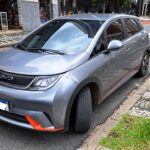
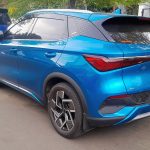
The night before the track day, I kept thinking about one question: what makes a BYD starting at 170,000 yuan dare to challenge the Model 3?
It’s not that I look down on BYD. I know the Blade battery’s safety reputation, and I know the Seal’s CTB technology, iTAC system, and double-wishbone suspension stacked on the spec sheet. But the track is not a spec sheet — no matter how many technical terms you list, corners still demand real skill.
With that question in mind, I took the Seal AWD onto the Shanghai International Circuit. Two hours later, my attitude had changed.
First Impressions in the Corners
The first lap was a tire-warming lap — I didn’t dare go too fast. But exiting T1, the Seal’s first impression on me was: stable.
Not the “dead heavy” kind of stable, but the “confident” kind. The steering pointed clearly, the nose responded eagerly, and the rear axle had no excess sway. I have driven this feeling in many cars — but at this price point, few cars can deliver this feedback.
On the second lap I started pushing. At T4, the high-speed corner, entry speed was raised to 145 km/h. A traditional front-drive EV at this speed would already start to understeer, with feedback on the steering wheel turning vague. But the Seal didn’t — the iTAC system sensed in advance that the front wheels were about to break traction and silently transferred torque to the rear axle. The nose was “dragged” back toward the apex, and flooring the throttle on exit didn’t produce any panicked torque steer.
At that moment I started to understand the thinking of BYD’s engineers: they weren’t trying to build a “hardcore track machine”, but a “high-tolerance sports sedan”. You can make mistakes — the car will rescue you.
What Is CTB Actually Good For?
Official data says the Seal’s torsional rigidity is 40,500 N·m/°. What does that mean? The BMW 7 Series and Mercedes S-Class are at this level.
But data is data, and feel is feel. In the track’s continuous corners, where does CTB technology show its value?
The answer is: body consistency.
Having driven many EVs, in spirited driving there is always a kind of “looseness” between the body and the chassis. The steering turns, the chassis responds, but the body seems half a beat late. This sense of asynchrony gets amplified on a high-rigidity body — the stiffer the body, the more obvious the uncoordinated details.
The Seal doesn’t have this problem. CTB makes the battery part of the body, and the whole car responds to your commands as one unit. However much you turn the steering, the nose turns that much — no delay, no fuzzy zones. This “directness” is very precious on the track.
Of course, good track performance doesn’t mean it’s easy to drive daily. But the Seal’s suspension tuning clearly considered daily scenarios — on the return highway, potholes and seams were filtered quite delicately. Not the rock-hard kind that “gives you all the road feel”, but rather “keeping what should be kept, filtering what should be filtered”.
Compared with the Model 3, Which Is Better to Drive?
I asked myself this question many times.
If you put the two cars side by side, the conclusion is: they are two completely different driving philosophies.
The Model 3 is “hardcore sport”. Firm suspension, direct road feel, heavy steering — every road detail gets amplified and delivered. For drivers who love “man-machine unity”, the Model 3 provides the purest mechanical fun — but at the cost of daily driving comfort. You need to slow down for speed bumps and be careful over potholes, or passengers will complain.
The Seal is “comfortable sport”. The high rigidity brought by CTB technology keeps the chassis stable in spirited driving, but the suspension tuning clearly leans toward daily comfort. You can explore its limits on the track, and enjoy its damping performance in daily commutes.
Which is better? It depends on what you want.
If you want pure driving fun and don’t care about comfort, the Model 3 suits your taste better. But if you need a car that is easy to drive daily, can occasionally hit the track, and still looks after your family’s feelings, the Seal is the more balanced choice.
iTAC: The Invisible Safety Net
In the slalom test I deliberately probed the Seal’s limits. At the third cone, I entered at too high a speed and the rear axle started to slide slightly.
In a traditional rear-drive car, at that moment your heart would race — the tail is swinging out, you need to counter-steer to save the car. But the Seal didn’t give me that chance. Before I could even perceive the slide, the iTAC system had already completed torque redistribution. The tail was “dragged” back, the whole process silent and seamless.
This is not a loss of “driving fun” — it is an upgrade of “fault tolerance”. For most non-professional drivers, you can explore the car’s limits with more confidence without worrying about losing control.
Of course, hardcore players may feel this kind of intervention “robs” driving fun. But then again, among consumers buying cars at this price, how many are hardcore players?
Range and Charging: Adequate, But Not a Highlight
After the track day, the Seal’s power consumption surprised me — two hours of spirited driving drained about 55% of the battery. At this consumption rate, the AWD version’s CLTC 600 km range might only translate to just over 200 km in track mode.
This is not the Seal’s problem — it is the common fate of all EVs. Spirited driving is power-hungry, with no shortcuts.
For charging, the official rated peak power is 150 kW. But in real experience, not many chargers can feed that rate. On a State Grid 120 kW fast charger in the south, the measured peak was about 93–119 kW, with 30%–80% charging taking about 42 minutes.
The Seal’s advantage lies in good charging compatibility — it supports voltage-boost fast charging and adapts to multiple charger types. On many third-party chargers, its performance is more stable than some “picky” EVs.
My Verdict
The Seal is not a perfect car. Its driver-assistance system still lags behind Tesla, highway tire noise is obvious, and the steering feel is on the light side.
But it is an “honest” car. BYD didn’t try to package the Seal as a “track weapon” that surpasses the Model 3 — instead, the goal was: to offer an electric sedan that is easy to drive daily, can occasionally have fun, and is reasonably priced.
Starting at 175,800 yuan, with double-wishbone plus five-link suspension, CTB technology, the iTAC system, and the Blade battery’s safety DNA — at this price, these configurations already show enough sincerity. It may not be able to kill the Model 3 in corners, but it can give you more in daily scenarios.
For most consumers, the latter is what truly matters.
— Sources: track test experience, BYD official technical documentation (March 2026)