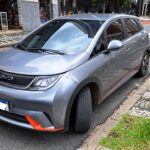
Honestly, when I first saw the BYD Atto 3, I was a bit dismissive. Another Chinese-made EV going overseas — how capable could it be? But after a week of test driving, my attitude did a 180-degree turn.
This isn’t saying the Atto 3 is perfect — far from it. But it did hit Australia’s most painful spot: at the right time, at the right price, offering just the right product strength.
Starting with a Tire
Let’s chat about a tiny detail: the 2025 Atto 3 switched tires to Continental EcoContact 6Q.
Why is this worth mentioning? Because the old Atlas Batman tires, to put it politely, were adequate; to put it bluntly — on wet roads, they’d give you an unprecedented piety toward Buddha. I tested the old model’s braking distance in the rain at 60km/h — the heart-pounding kind.
After the new tires went on, wet grip improved noticeably; that the steering wheel turned but the nose still plunges forward unease disappeared. BYD did listen to the market’s complaints this time.
From this detail you can see two things: one, BYD is indeed taking Australian market feedback seriously; two, they previously did have a bit of save where you can — which happens to be the common disease of many Chinese brands going overseas.
AUD 40,000 — What Do You Get?
In the Australian market, the Essential trim sells for AUD $39,990, the Premium $44,990. Converted to RMB, roughly 185,000 and 208,000.
The domestic Yuan PLUS guide price is 115,800-145,800 yuan. Seeing this price difference, you might say: isn’t this price gouging?
I don’t see it that way.
You have to think about what’s included in those tens of thousands of AUD difference: import tariffs, transportation costs, Australian local certification (ADR certification is no joke), dealer network building, after-sales service system… More importantly, the Australian EV market’s competitive landscape is completely different from China’s.
What are the competitors at the same price point? MG4 starts at $38,990 but has nearly 100 km less range; Tesla Model Y RWD costs $55,900; Nissan Leaf is about to be eliminated with its CHAdeMO interface; Hyundai Kona Electric starts at $54,500…
In the AUD 40,000-45,000 range, the Atto 3 is almost the only choice offering 400+ km range, ANCAP five-star safety, panoramic sunroof, complete ADAS. This is its real home turf.
420 km Range? Real Tests Tell You the Truth
The Premium trim’s official WLTP range is 420 km. Based on my week of mixed-road testing — including city commuting, highway cruising, and a stretch of mountain road — actual range is about 360-380 km.
City commuting performs best, reaching 380+ km with air conditioning on; highway cruising at 110km/h drops to around 330 km. This gap from official data is within a reasonable range — much more reliable than some MIIT range claims.
For charging, it supports up to 88kW DC fast charging, 30%-80% in about 29 minutes. Honestly, this power isn’t fast by 2025 standards — Tesla V3 superchargers reach 250kW, Hyundai IONIQ 5 reaches 350kW. But considering the current state of Australian charging infrastructure, the 88kW real experience may not be worse than higher power, because many public charging piles can’t reach higher power themselves.
Home 7kW AC charging fills in 9 hours. If you have your own garage and solar panels, the Atto 3’s running costs are almost negligible.
Interior: Has Ideas, But Tries Too Hard
The Atto 3’s interior design is my favorite part to criticize — and the place that best shows Chinese brands’ trying too hard syndrome.
An ocean theme runs through the whole car: guitar-string-shaped storage straps on door panels (actually playable, but I really can’t figure out the use case for this function), round door handles integrated with ambient lighting, lots of curved elements on the center console… The designers obviously wanted to write differentiation on their faces.
The problem is, differentiation doesn’t equal good.
The 15.6-inch rotating touchscreen is the biggest controversy. Supports landscape/portrait switching — sounds cool, right? But after three days of driving I found that in vertical mode navigation information displays incompletely, and in horizontal mode it blocks the air vents. And this screen’s UI logic is a bit counterintuitive, with deep menu levels — it took me several days to adapt.
The 5-inch LCD instrument cluster leaves me speechless. Too small, insufficient information density, severe glare in sunlight. For a car at this price point, why can’t it have a bigger instrument cluster?
But to be fair, rear space is unexpectedly generous. 2720mm wheelbase isn’t big by compact SUV standards, but rear legroom approaches mid-size SUV levels. Flat floor — middle passengers don’t need to hunch their legs. This is where I give the Atto 3 interior bonus points.
Driving: Comfort-Oriented, Don’t Expect Sportiness
7.3 seconds to 100km/h (Premium trim) — this number is adequate among EVs. Indeed there’s no Model Y-style push-back feeling when you stomp the accelerator, but daily overtaking is absolutely enough.
Steering feel is on the light side — my preferred type: not tiring to drive in the city. But if you expect any driving fun, abandon that thought early. The Atto 3’s suspension tuning is clearly comfort-oriented, body-roll suppression is average — aggressive driving will remind you this is a family car.
Energy recovery system supports multi-level adjustment. Although there’s no one-pedal mode (a pity), daily driving is composed enough. I habitually set regen to medium — recovers energy without making passengers carsick.
NVH performance is middling. Highway wind noise is controlled okay, but tire noise on coarse asphalt is noticeable — related to its eco tires; grip and quietness always need trade-offs.
Configuration and Safety: Has Everything It Should
Premium trim standard: panoramic sunroof, wireless phone charging, front seat heating, electric tailgate, 360° panoramic view, adaptive cruise, lane-keeping assist, blind-spot monitoring… basically every configuration at this price point is there.
ANCAP five-star safety rating, whole-vehicle warranty 6 years/150,000 km, battery warranty 8 years/160,000 km. For first-time EV-buying family users, this guarantee is reassuring enough.
But I must complain: the driver assist intervention logic is a bit too aggressive. Lane-keeping forcibly grabs the steering wheel when you change lanes without signaling; adaptive cruise’s default following distance is conservative, always getting cut off. Luckily these can all be adjusted in settings.
My Verdict
The Atto 3 is not a perfect car. Its interior design tries too hard, fast-charging power lags behind the times, driving quality has few highlights worth mentioning.
But it caught the most crucial point: in the right price range, offering the right product strength.
Just over AUD 40,000 gets you a pure electric SUV with reliable range, rich configuration, up-to-standard safety. For Australian family users — especially those with their own house, able to install charging piles, with daily commutes within 50 km — the Atto 3 is almost the most rational choice.
This isn’t a car that gets your blood pumping, but it’s a car that makes you feel grounded using it every day.
And in my view, for most ordinary consumers, the latter is what truly matters.
— Sources: CarExpert, EV Central, BYD Australia official site (March 2025), plus author’s one-week test drive experience