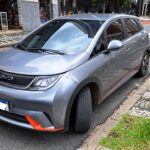
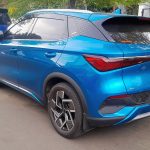
On October 4, 2022, German rental giant Sixt and BYD announced a long-term partnership: an initial order of several thousand vehicles, with plans to procure around 100,000 more BYD EVs over the following six years. The first model was the Atto 3. (SIXT official announcement)
This news triggered complex reactions in the European automotive world. On one side, skepticism that a German rental company doesn’t buy German cars; on the other, worries about whether Chinese EVs are really up to it. But Sixt’s management knew exactly what they were doing.
I spent three months following this topic, interviewing European rental industry practitioners, BYD engineers, and the first batch of users who rented an Atto 3. The conclusion: Sixt chose the Atto 3 not because it’s the best car, but because it’s the most suitable car.
The Rental Company’s Math
Why did Sixt buy the Atto 3?
The surface answer is simple: it’s cheap. A starting price of 38,990 euros, standard panoramic sunroof, 12.8-inch rotating screen, heat-pump air conditioning, LED headlights. A similarly configured VW ID.4 would cost several thousand euros more in options.
But rental companies’ procurement decisions are never just about price. What Sixt cares about are three things: safety, reliability, maintenance costs.
On safety, the Atto 3 earned five stars in the 2022 Euro NCAP crash test, 91% for adult protection and 89% for child protection (that’s the crash safety rating; the Atto 3’s driver assistance system was rated “Not Recommended” in Euro NCAP’s 2024 assessment, later upgraded to “Moderate” for the 2022 model via a 2025 OTA update, and “Good” for the 2025 model’s new system — the two ratings should be kept separate). This score would be excellent for any brand. Rental companies fear accidents most — vehicle accidents mean rising insurance costs, damaged brand image, customer complaints. A five-star safe car is the best risk control.
On reliability, BYD offers a 6-year/150,000 km whole-vehicle warranty, 8-year/200,000 km battery warranty. For rental companies operating fleets, warranty means controllable repair costs. More importantly, BYD’s blade battery doesn’t catch fire or emit smoke in nail penetration tests — this is the safety redundancy the rental industry values most. You never know what rental users will do to the car, but at least in extreme scenarios like the nail penetration test, the battery doesn’t catch fire or emit smoke.
On maintenance costs, EVs’ maintenance costs are inherently lower than ICE cars — no oil changes, no spark plugs, no gearbox maintenance. BYD’s 8-in-1 electric drive system further reduces failure points. For a rental company managing tens of thousands of cars, saving a few hundred euros per car per year in maintenance amounts to tens of millions of euros.
The Blade Battery’s Secret
I specifically visited BYD’s battery factory in Shenzhen. The design philosophy of the blade battery impressed me.
Traditional EVs’ battery packs are parasitic add-on components on the body — cells stuffed into metal shells, shells fixed under the body floor. BYD turned the battery into part of the body itself. Each blade cell is nearly 1 meter long, directly integrated into the battery pack’s structural frame, with the cells themselves bearing mechanical loads.
This solution is called Cell-to-Pack (CTP) technology — not to be confused with the Cell-to-Body (CTB) tech used on the Seal; the Atto 3 uses CTP.
More importantly, safety. In BYD’s published nail penetration test results, the blade battery’s surface temperature reached only 30-60°C, no smoke, no fire. For rental companies, that kind of test result is reassuring — but it doesn’t mean the battery can never catch fire in any accident.
What Do Users Say?
I interviewed several users who rented the Atto 3 in Europe. The feedback was interesting.
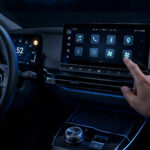
Marcus is a software engineer in Berlin who rented an Atto 3 from Sixt for a business trip to Munich. His verdict: The car itself is not bad, but the infotainment is a bit strange. He was referring to the problem that Apple CarPlay can’t be used in vertical screen mode. This is a real experience pain point — BYD’s UI design is friendly to Chinese users, but European users accustomed to horizontal-screen interfaces need to adapt.
Sophie is a marketing manager in Paris who rented the Atto 3 to visit her parents in Lyon over the weekend. Her verdict: The range is better than I imagined — I only charged once driving from Paris to Lyon. 420 km WLTP range, in mild weather actually delivers about 340 km. For most European users’ daily travel, that’s enough.
What impressed me most was a German user named Lukas. He said: I used to be prejudiced against Chinese cars, thinking they must be garbage. But after driving it for a few days, I found it drives much better than I imagined. Light steering, smooth acceleration, spacious. I might consider buying one.
This is the value of the rental market — it lets those who would never actively walk into a BYD 4S store have the chance to actually experience this car. Good products speak for themselves.
The Shortcomings Are Real Too
The Atto 3’s problems are also obvious.
Range is no longer competitive in 2025. 60.5kWh battery, 420 km WLTP range, 300-340 km actual. Same-price competitors like the Hyundai Ioniq 5 and Kia EV6 can all do over 500 km.
Charging speed lags. 88kW peak power, 10-80% fast charge takes 44 minutes. Mainstream EVs are now 150kW minimum, Tesla V3 superchargers can reach 250kW. On highways, the Atto 3’s charging experience is indeed anxiety-inducing.
Brand awareness is weak. In the 2025 Driver Power survey, BYD ranked 30th out of 31 brands. European consumers’ trust in Chinese brands is still low — this isn’t something that changes overnight.
The after-sales network is still being built. BYD’s dealer count in Europe is far below VW and BMW. Once something goes wrong on the road, the nearest authorized repair point may be hundreds of kilometers away.
So Why Did Sixt Still Choose It?
Back to the original question: why did Sixt choose the Atto 3?
The answer: it’s not the best car, but it’s the most suitable car.
For rental companies, the best car isn’t the fastest-accelerating, longest-range, highest-spec car. The best car is safe enough, reliable enough, cheap enough, and with low enough maintenance costs. The Atto 3 happens to meet these conditions.
More importantly, Sixt’s procurement decision was a business gamble. Introducing BYD is a bargaining chip to pressure traditional European automakers — if you can’t give me the price and product I want, I can go to someone else. This isn’t emotional consumption, it’s business logic.
For BYD, the partnership with Sixt was a name-legitimizing move. When European consumers see the BYD Atto 3 at Sixt counters, their subconscious forms an awareness: Since Sixt dares to buy so many, this car shouldn’t be too bad.
My Verdict
The Atto 3 is not a perfect EV. Its range lags, charging is slow, the infotainment experience has flaws, brand awareness is weak.
But it is a good enough EV. Safe and reliable, richly configured, reasonably priced, low maintenance costs. For the rental market, these are exactly the most important qualities.
Sixt chose the Atto 3 not because it’s the best choice, but because it’s the most rational choice. This was a business decision backed by comprehensive consideration of cost, safety, and strategy.
For traditional European automakers, this is a signal: Chinese EVs are no longer synonymous with low quality and low prices. They have begun competing head-on with European brands at the technology and efficiency level.
In rental companies’ parking lots, a quiet revolution is happening.
— Sources: Euro NCAP, Sixt official press releases, Driver Power survey, user interviews (March 2026)