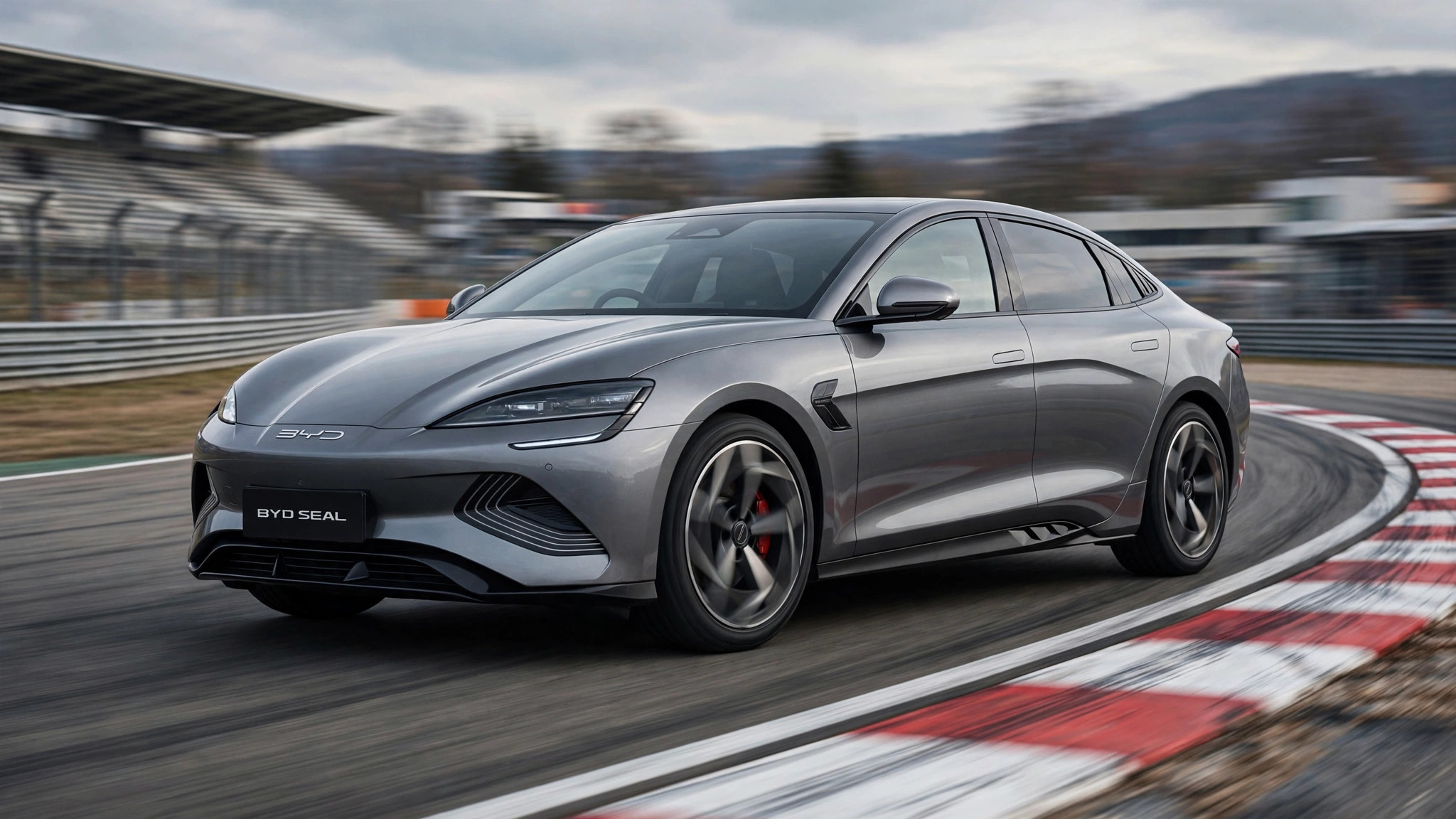

The night before track day, I kept asking myself one question: what gives a BYD Seal — starting at ¥175,800, with the AWD version tested here at ¥239,800 (2025 model) — the nerve to challenge the Model 3? (The car tested here is the AWD version.)
It’s not that I look down on BYD. I know the Blade Battery’s safety reputation. I know the Seal packs CTB technology, the iTAC system, double-wishbone suspension. But a track isn’t a spec sheet — no matter how many technical terms you list, corners demand real ability.
With that question in mind, I took the Seal AWD onto the Shanghai International Circuit. Two hours later, my attitude had changed.
First Impressions in the Corners
The first lap was a warm-up — I didn’t push. But at the T1 exit, the Seal’s first message was: stable.
Not a dead, heavy kind of stable — a confident stable. The steering pointed cleanly, the nose responded eagerly, the rear axle had no wasted movement. I’ve driven many cars; at this price, few give you this kind of feedback.
Second lap, I started pushing. T4, a fast corner, entry at 145 km/h. A conventional front-drive EV would be understeering by now, steering feedback going vague. But the Seal didn’t — I could feel the iTAC system working: as the front tires approached their grip limit, power seemed to be quietly shifted rearward (this is seat-of-the-pants feel — no telemetry data to confirm the exact trigger timing or torque split). The nose was pulled back toward the apex; full throttle on exit with no panicky torque steer.
That’s when I started to understand the BYD engineers’ thinking: they weren’t building a “hardcore track machine.” They were building a “high-forgiveness sports sedan.” You can make mistakes, and the electronics will step in early to steady the car (driving feel, not a safety promise).
What Does CTB Actually Do?
Official figures put the Seal’s torsional rigidity at 40,500 N·m/°. For context, that’s BMW 7 Series and Mercedes S-Class territory.
But numbers are numbers; feel is feel. Where does CTB technology show its value in a sequence of corners?
The answer: consistency.
Driving many EVs hard, you often feel a “looseness” between body and chassis. You turn the wheel, the chassis responds, but the body seems half a beat behind. That disconnect gets amplified in a stiff body — the stiffer the shell, the more obvious the incoherence.
The Seal doesn’t have this problem. CTB makes the battery part of the body, so the whole car responds as one piece. Turn the wheel this much, the nose turns that much — no delay, no vagueness. That directness is precious on track.
Of course, good on track doesn’t automatically mean good on road. But the Seal’s suspension tuning clearly considered daily driving — on the highway home, potholes and seams were filtered with finesse. Not the “feel everything” hardness, but “keep what matters, filter what doesn’t.”
Against the Model 3: Which Drives Better?
I asked myself this many times.
Put the two side by side and the conclusion is: they’re completely different driving philosophies.
The Model 3 is “hardcore sport.” Stiff suspension, direct road feel, heavy steering — every road detail amplified. For drivers who love that connected feeling, the Model 3 delivers the purest mechanical joy. The price is daily comfort. You slow for speed bumps, tiptoe around potholes, or your passengers complain.
The Seal is “comfortable sport.” CTB’s rigidity keeps the chassis composed when pushed, but the suspension is clearly tuned for daily comfort. You can explore its limits on track, then enjoy its ride quality on the commute home.
Which is better? Depends what you want.
If you want pure driving fun and don’t care about comfort, the Model 3 is your car. But if you need something pleasant daily, capable on occasional track days, and considerate of your family’s comfort, the Seal is the more balanced choice.
iTAC: The Invisible Safety Net
In a slalom test I deliberately probed the Seal’s limits. Third cone, I carried too much speed in — the rear started to step out slightly.
In a traditional rear-driver, your heart would skip — the tail sliding out, needing opposite lock to catch it. But the Seal never gave me the chance. Before I even perceived the slide, iTAC seemed to have already intervened — the tail was pulled back in, the whole thing seamless (again, driving feel, not instrument-verified).
This isn’t a loss of “driving pleasure” — it’s a gain in “forgiveness.” For most non-professional drivers, you can explore the car’s limits with more confidence and less fear of losing it.
Hardcore enthusiasts might feel this intervention “robs” them of fun. But honestly — at this price, how many buyers are hardcore enthusiasts?
Range and Charging: Adequate, Not Stellar
After track day, the Seal’s consumption surprised me — two hours of hard driving used about 55% of the battery. At that rate, a track day clearly won’t last all day on one charge.
That’s not the Seal’s fault — it’s every EV’s fate. Hard driving drinks electricity. No shortcuts.
On charging, the official peak is 150 kW. But in practice, few chargers can actually deliver it. On a 120 kW public charger, I measured 93–119 kW peak, with 30–80% taking about 42 minutes (my own measured sample, not lab conditions; BYD’s official figures for the 2025 model are up to 180 kW, 10–80% in about 25 minutes, 10–100% in about 43 minutes).
The Seal’s strength is charging compatibility — it supports boost charging and works with many charger types. On third-party chargers, it’s more consistent than some pickier EVs.
My Verdict
The Seal isn’t a perfect car. Its driver-assist systems lag Tesla’s, highway tire noise is noticeable, and the steering feels light.
But it’s an “honest” car. BYD didn’t try to package the Seal as a Model 3-beating “track weapon.” The goal was: a daily-drivable car that’s fun when you want it to be, and kind to your family the rest of the time.
At this price, that’s a compelling proposition — and on track, it earned my respect.