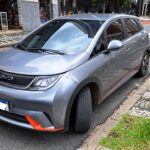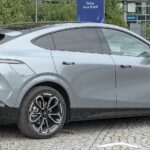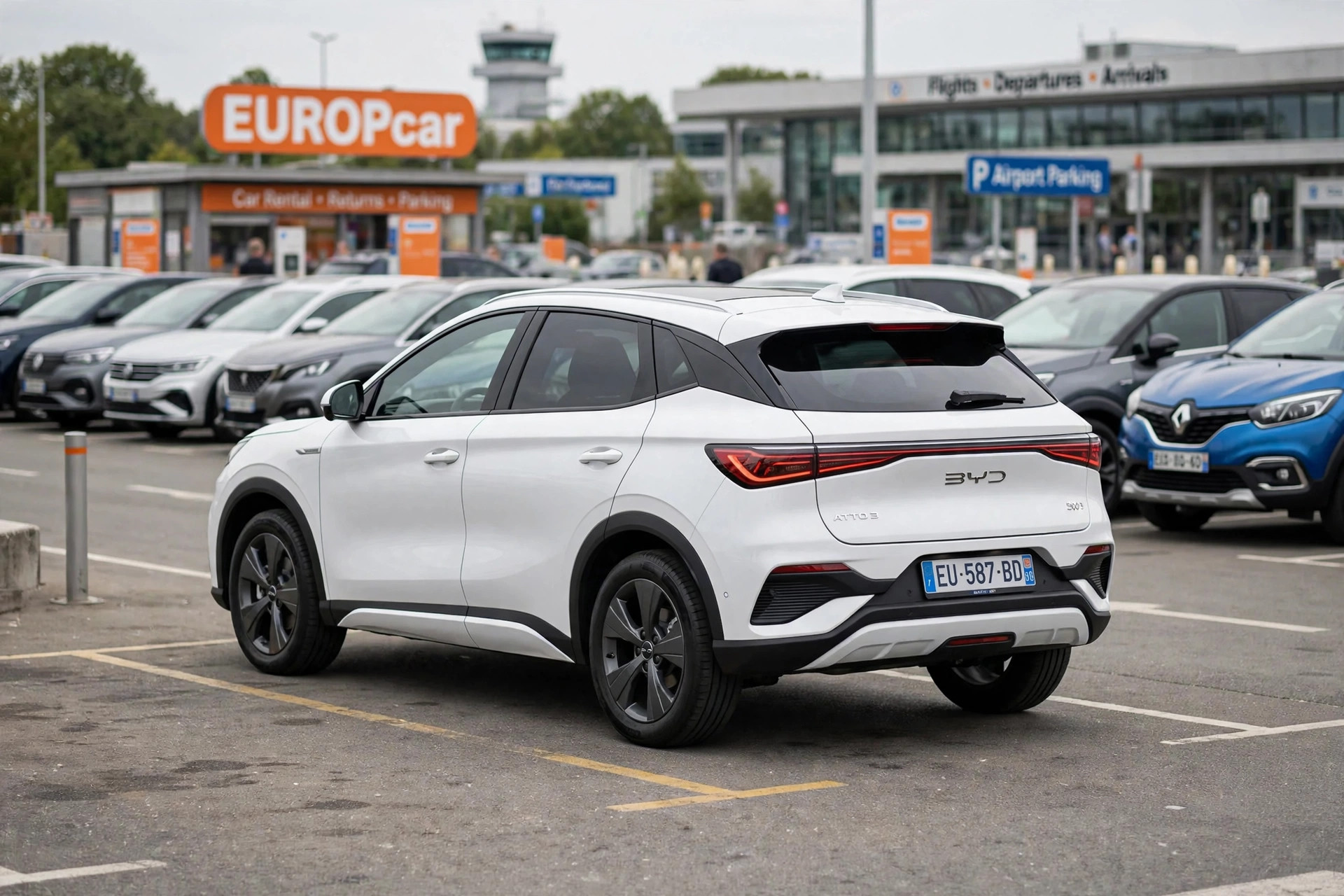

On October 4, 2022, German rental giant Sixt and BYD announced a long-term partnership: an initial order of several thousand vehicles, with plans to procure around 100,000 more BYD EVs over the following six years. The first model? The Atto 3. (SIXT official announcement)
The news triggered mixed reactions across Europe’s auto circles. On one side: “A German rental company not buying German cars?” On the other: “Are Chinese EVs actually any good?” But Sixt’s management knew exactly what they were doing.
I spent three months tracking this story, talking to European rental industry insiders, BYD engineers, and some of the first customers to rent an Atto 3. My conclusion: Sixt didn’t choose the Atto 3 because it’s the best car. They chose it because it’s the most suitable car.
The Rental Company’s Math
Why did Sixt buy the Atto 3?
The surface answer is simple: it’s cheap. A starting price of €38,990 with panoramic sunroof, 12.8-inch rotating screen, heat pump, and LED headlights as standard. A similarly equipped VW ID.4 costs thousands more in options.
But rental companies never buy on price alone. Sixt cares about three things: safety, reliability, and maintenance costs.
On safety, the Atto 3 earned five stars in the 2022 Euro NCAP crash test — 91% for adult protection, 89% for child protection (that’s the crash safety rating; the Atto 3’s driver assistance system was rated “Not Recommended” in Euro NCAP’s 2024 assessment, later upgraded to “Moderate” for the 2022 model via a 2025 OTA update, and “Good” for the 2025 model’s new system — the two ratings should be kept separate). That’s excellent by any brand’s standard. Rental companies dread accidents: they mean higher insurance premiums, damaged brand image, and customer complaints. A five-star car is the best risk control.
On reliability, BYD offers a 6-year/150,000 km vehicle warranty and 8-year/200,000 km battery warranty. For a fleet operator, warranty means controllable repair costs. More importantly, the Blade Battery doesn’t catch fire or smoke in nail penetration tests — the kind of safety margin the rental industry values most. You never know how renters will treat a car, but at least in extreme scenarios like the nail penetration test, the battery doesn’t catch fire or smoke.
On maintenance, EVs are inherently cheaper to maintain than combustion cars — no oil changes, no spark plugs, no gearbox servicing. BYD’s 8-in-1 electric drive system further reduces failure points. For a company managing tens of thousands of vehicles, saving a few hundred euros per car per year adds up to tens of millions.
The Blade Battery’s Secret
I visited BYD’s battery factory in Shenzhen. The Blade Battery’s design philosophy impressed me.
In a conventional EV, the battery pack is a “parasite” bolted onto the body — cells stuffed into a metal shell, the shell fixed under the floor. BYD made the battery part of the body itself. Each blade cell is nearly a meter long, integrated directly into the pack’s structural frame, with the cells bearing mechanical loads.
This is called Cell-to-Pack (CTP) technology — not to be confused with the Cell-to-Body (CTB) tech used on the Seal; the Atto 3 uses CTP.
More importantly: safety. In BYD’s published nail penetration test results, the Blade Battery’s surface temperature reached only 30–60°C — no smoke, no fire. For a rental company, that kind of test result is reassuring — but it doesn’t mean the battery can never catch fire in any accident.
What Do Renters Say?
I interviewed several Europeans who rented an Atto 3. The feedback was revealing.
Marcus, a software engineer in Berlin, rented one from Sixt for a business trip to Munich. His verdict: “The car itself is fine, but the infotainment is a bit odd.” He meant the portrait screen — Apple CarPlay doesn’t work in vertical mode. A genuine UX pain point: BYD’s interface is friendly to Chinese users, but Europeans used to landscape screens need time to adapt.
Sophie, a marketing manager in Paris, rented an Atto 3 for a weekend trip to visit her parents in the countryside. “The range was better than I expected — only one charging stop from Paris to Lyon.” The 420 km WLTP range delivers around 340 km in mild weather. For most European daily driving, that’s enough.
What struck me most was Lukas, a German renter. “I was biased against Chinese cars — assumed they’d be rubbish. But after a few days, it drove much better than I expected. Light steering, smooth acceleration, plenty of space. I might actually consider buying one.”
That’s the value of the rental market: it puts people behind the wheel who would never walk into a BYD showroom. A good product speaks for itself.
The Flaws Are Real Too
The Atto 3’s problems are equally clear.
Range is no longer competitive. A 60.5 kWh battery, 420 km WLTP, 300–340 km in reality. A similarly priced Hyundai Ioniq 5 or Kia EV6 does 500+ km.
Charging is slow. 88 kW peak, 44 minutes for 10–80%. Mainstream EVs now start at 150 kW; Tesla’s V3 Superchargers hit 250 kW. On the highway, the Atto 3’s charging experience causes real anxiety.
Brand recognition is weak. In a 2025 Driver Power survey, BYD ranked 30th out of 31 brands. European consumer trust in Chinese brands remains low — that won’t change overnight.
The service network is still being built. BYD has far fewer European dealers than VW or BMW. If something goes wrong on the road, the nearest authorized repair shop could be hundreds of kilometers away.
So Why Did Sixt Still Choose It?
Back to the original question: why the Atto 3?
Because it’s not the best car — it’s the most suitable car.
For a rental company, the best car isn’t the fastest, longest-range, or most feature-packed. It’s the one that’s safe enough, reliable enough, cheap enough, with low enough maintenance costs. The Atto 3 checks those boxes.
More importantly, Sixt’s decision is a business play. Bringing in BYD is leverage against Europe’s legacy automakers: if you won’t give me the price and product I want, I’ll go elsewhere. This isn’t sentiment — it’s commercial logic.
For BYD, the partnership with Sixt is a coming-out party. When European consumers see BYD Atto 3s at the Sixt counter, the subconscious message forms: “If Sixt dares to buy this many, it can’t be that bad.”
My Take
The Atto 3 is not a perfect EV. Its range lags, charging is slow, the infotainment has quirks, and brand awareness is thin.
But it’s a “good enough” EV. Safe, reliable, well-equipped, reasonably priced, cheap to maintain. For the rental market, those are precisely the qualities that matter most.
Sixt didn’t choose the Atto 3 because it was the best option. They chose it because it was the most rational one — a commercial decision weighing cost, safety, and strategy.
For Europe’s legacy automakers, this is a signal: Chinese EVs are no longer synonymous with “cheap and nasty.” They’re competing head-on in technology and efficiency.
A quiet revolution is happening in rental company parking lots.
— Sources: Euro NCAP, Sixt press releases, Driver Power survey, user interviews (March 2026)