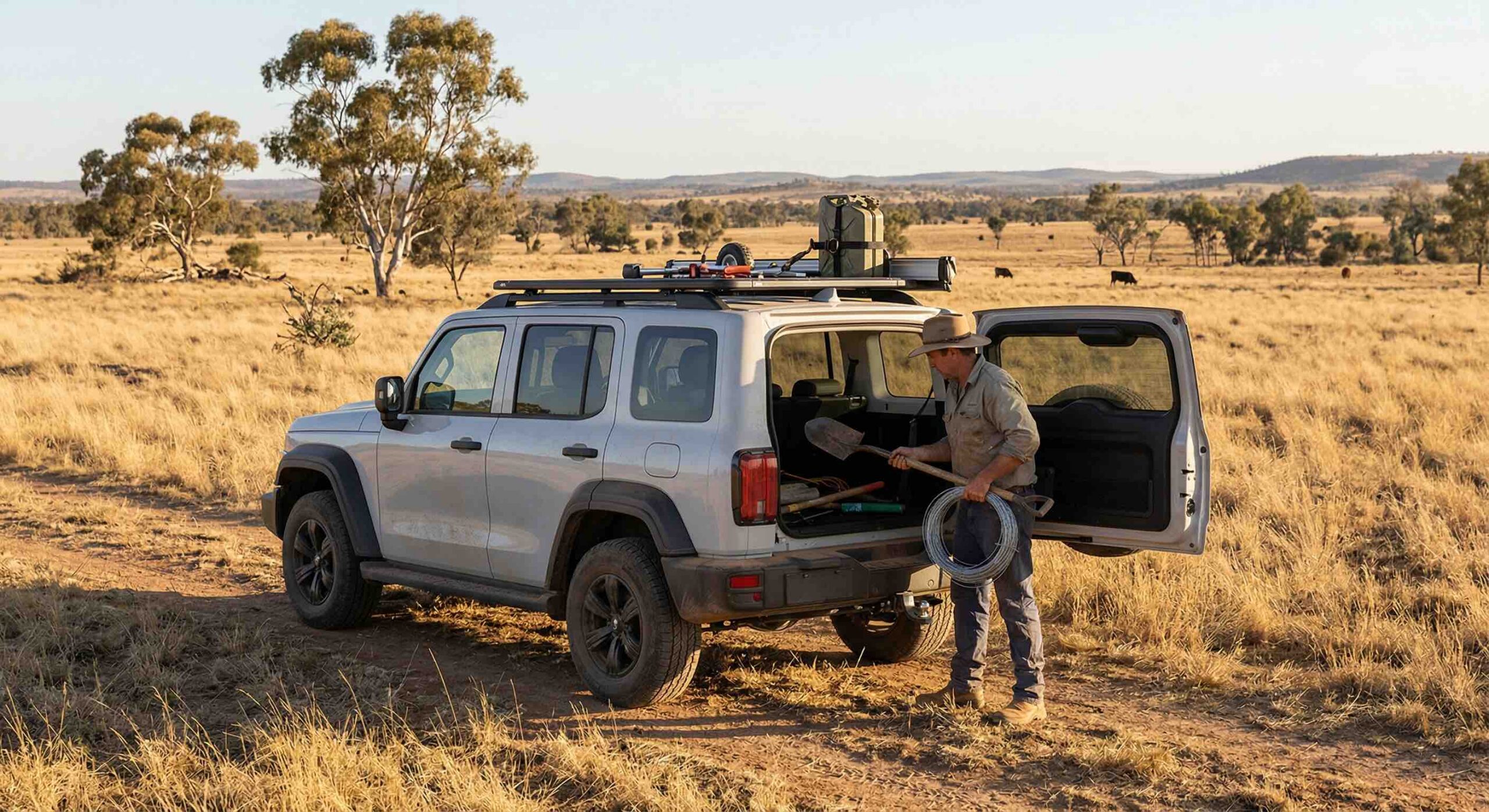

How does a Chinese off-roader gain a foothold in the Southern Hemisphere’s “off-road paradise”? The answer is more than just price.
When the Diesel Engine Roars, the Story of the Australian Outback Begins
In March 2025, on a mountain road east of Melbourne, a boxy SUV was climbing a slope. From under the hood came not the crisp sound of a gasoline engine but the diesel’s signature “clatter” — the very sound Australian buyers had waited a full two years for.
The Great Wall Tank 300 diesel version has finally gone on sale in the Australian market.
This is not an ordinary model launch. For GWM Australia, this car’s significance goes far beyond sales figures. “If there had been a diesel version, I would have bought it.” Over the past two years, this sentence repeatedly appeared in lost customers’ feedback. 75% of large SUV competitors are diesel cars, while the Tank 300 previously only had gasoline and hybrid — in Australia, that was like driving an off-roader without 4WD across the Simpson Desert.
Now the question has changed: with the diesel version finally here, can it become the “reliable partner” of Australian ranchers, mine workers, and off-road enthusiasts?
Let us understand a continent’s vehicle logic through a 50,000-Australian-dollar Chinese off-roader.
Are the “Fundamentals” of Hardcore Off-Roading Solid Enough?
Body-on-Frame: The Heart of an Off-Roader
Opening the Tank 300’s spec sheet, the first line reads “body-on-frame.” What does this mean? Simply put, the body and frame are separate — the frame carries the engine, gearbox, suspension and other core components, while the body “sits” on top of the frame.
This is the signature design of traditional off-roaders. The Jeep Wrangler, Toyota Land Cruiser, Ford Bronco — all follow this path. Why? Because an independent frame withstands greater torsion and impact, and won’t “twist and deform” under extreme conditions like a unibody.
The Tank 300’s ladder frame uses high-strength steel; the front suspension is double-wishbone independent, while the rear is a five-link solid axle. This combination is called the “golden configuration” in off-road circles — the front independent suspension ensures paved-road comfort, while the rear solid axle provides the strongest durability and grip in harsh conditions.
Let the data speak: approach angle 32 degrees, departure angle 33 degrees, ground clearance 224mm, wading depth 700mm. For comparison, the Jeep Wrangler’s approach angle is 34 degrees and departure angle 29 degrees. In other words, the Tank 300’s passability is no worse than this class’s benchmark.
4WD System: BorgWarner’s “Hardcore Solution”
The Tank 300 diesel uses a BorgWarner part-time 4WD system. Note: “part-time 4WD,” not “full-time 4WD.”
The difference concerns off-road philosophy. Part-time 4WD uses rear-wheel-drive mode (2H) on normal paved roads, switching to 4WD mode (4H or 4L) only when unsticking is needed. The benefit of this approach: simple structure, reliable and durable, low maintenance costs — you don’t need a complex center differential to handle front-rear axle speed differences.
The Tank 300’s center transfer case can multiply torque 2.48 times. After engaging low-range 4WD (4L) mode, the engine’s torque output is amplified nearly 2.5 times, combined with front and rear Eaton electric differential locks — theoretically able to handle the vast majority of off-road scenarios.
How fast do the differential locks respond? 200 milliseconds. In other words, from the system detecting slip to the lock engaging takes only a blink. This is crucial for desert bogging, mud recovery and other scenarios — faster locking means less bogging risk.
Diesel Engine: Tailor-Made for “Australian Needs”
The 2025 Tank 300 diesel carries a 2.4-liter turbocharged diesel engine, with maximum power of 135kW and peak torque of 480 N·m. This engine is no stranger — it is also used in the GWM Cannon pickup series.
Why did the diesel version arrive so late? GWM Australia’s explanation is candid: without market demand, there would be no product. And the Australian market’s demand is simple and crude — towing capability, fuel economy, low-end torque.
The diesel version’s arrival brings three key changes:
- Towing capacity raised from 2500kg to 3000kg: this means it can legally tow larger caravans, horse trailers or farm equipment. In the Australian outback, an SUV that can tow 3000kg is almost a rancher’s essential need.
- Payload raised from 400kg to 600kg: heavier cargo, fewer round trips. For users who frequently transport tools, feed, and equipment, this is a real efficiency boost.
- Combined fuel consumption down to 7.8L/100km: on Australian commutes spanning thousands of kilometers, fuel costs are a must-consider factor. Diesel’s energy advantage is infinitely magnified here.
To support these upgrades, GWM made “nearly 20” technical upgrades: larger brake discs, reinforced drive shafts, a new rear differential housing, upgraded wheel bearings… These invisible changes are the confidence behind the diesel version’s ability to “hold up.”
High-Temperature Stability: The Ultimate Test of the Australian Outback
In the Australian outback summer, temperatures regularly exceed 40 degrees Celsius. In such environments, a vehicle’s cooling system, drivetrain, even electronic components face severe tests.
The Tank 300’s cooling system uses a large radiator and auxiliary oil cooler. On the drivetrain side, part-time 4WD’s structure is inherently more heat-resistant than full-time 4WD — no viscous coupling to worry about overheating and failing. The 9-speed automatic gearbox comes from GWM’s in-house development, with targeted tuning on the diesel version to suit low-speed, high-torque output characteristics.
Of course, the real test can only be left to time and users. But at least from the hardware configuration, the Tank 300 diesel has the basic conditions to work in extreme environments.
What Can 50,000 Australian Dollars Buy?
Price War: Cheap Is an Advantage, but Not Everything
Let us look at the numbers directly:
| Model | Australian Starting Price (AUD) |
|---|---|
| Tank 300 Lux Diesel | 47,990 |
| Tank 300 Ultra Diesel | 51,990 |
| Jeep Wrangler Unlimited Sport | ~80,000 |
| Toyota Fortuner GX | ~55,000 |
| Ford Everest Ambiente | ~53,000 |
| Isuzu MU-X LS-T | ~58,000 |
The Tank 300 diesel’s price is about 30,000 AUD cheaper than the Jeep Wrangler, about 7,000 AUD cheaper than the Toyota Fortuner, and even lower than the Ford Everest’s entry model.
What does this mean? In Australia, 50,000 AUD is a psychological threshold — above this price, consumers start to hesitate; below it, they feel it is “worth it.” The Tank 300 Lux Diesel sits right on this threshold, while the higher-spec Ultra Diesel is only 2,000 AUD more.
More critically, the Tank 300’s configuration level far exceeds same-priced rivals. Take the Ultra Diesel as an example:
- 12.3-inch full LCD instrument cluster + 12.3-inch center screen
- Nappa leather seats with heating, ventilation, and massage functions
- 360-degree panoramic camera + transparent chassis
- Front and rear electric differential locks
- Wireless Apple CarPlay/Android Auto
- Heated steering wheel
- 9-speaker audio system
The same configuration on a Jeep Wrangler might cost you over 60,000 AUD. On a Toyota Fortuner, many configurations have no option at all.
The Wrangler Is Tougher, the Everest More Practical?
The Tank 300’s main competitors in the Australian market fall into two categories:
Hardcore off-road camp: Jeep Wrangler, Suzuki Jimny
The Wrangler is this segment’s benchmark, but its positioning is more “extreme” — removable roof and doors, a pure off-road machine. The Tank 300 is more like an “urban SUV that can off-road”: higher comfort, richer tech configuration, but missing some “hardcore flavor.”
The Jimny follows another logic — cheap (about 30,000 AUD), compact, but only four seats and weak power. The Tank 300 crushes it in space and power, though it costs nearly 20,000 AUD more.
Practical tool camp: Toyota Fortuner, Ford Everest, Isuzu MU-X
These three are all pickup-platform-based SUVs, focused on practicality and reliability. All are diesel-powered, all have strong towing capability, all have mature after-sales service networks.
The Tank 300’s disadvantage against them is brand recognition and after-sales service. Toyota’s dealer network covers Australia most broadly; Ford and Isuzu are not weak either. Although GWM has expanded rapidly in recent years, its service capability in remote areas remains an unknown.
But the Tank 300 also has unique advantages: it feels more like a passenger car than a tool vehicle. Interior luxury, tech configuration, driving comfort all outperform these three “pickup-converted SUV” products.
Who Is the Tank 300’s “Ideal Owner”?
Based on product positioning and market analysis, the Tank 300 diesel’s ideal user profiles in Australia look roughly like this:
Scenario one: small-to-medium ranchers
They need an SUV that can tow horse trailers, handle dirt roads, and work normally in 40-degree heat. But they don’t need a Toyota Land Cruiser-level “tank” — budgets are limited, and daily commuting comfort is also needed.
The Tank 300’s 3000kg towing capacity is enough, its 7.8L fuel consumption acceptable, its 50,000 AUD price affordable. If GWM can prove the diesel version’s reliability, this user group will become the Tank 300’s most loyal customers.
Scenario two: young families + weekend off-road enthusiasts
They live in city suburbs, commute by car on weekdays, and take kids camping, fishing, off-roading on weekends. They want a car that looks cool, is richly configured, can handle rough roads — but budgets are limited and cannot afford the Wrangler’s premium.
The Tank 300 fits this need perfectly: five-seat space is enough, the trunk’s 400L expandable to 1635L, off-road capability sufficient for light-to-moderate off-road scenarios.
Scenario three: small business owners
They need a car that can both haul goods and meet clients. Pickups are too crude; traditional SUVs are not tough enough. The Tank 300’s “off-road style” brings a unique image, while the 50,000 AUD price is acceptable to small business owners.
Which One to Choose?
If you are a pragmatic rancher or tool-vehicle user, the Lux Diesel is enough. It already includes everything you need: 4WD system, rear differential lock, panoramic camera, leather seats. The 4,000 AUD saved can be spent on roof racks, winches and other modifications.
If you pursue comfort, or want more complete off-road configuration (front differential lock), choose the Ultra Diesel. Nappa leather seats, heated steering wheel, seat massage and other functions will make long-distance driving more enjoyable.
As for the hybrid version? In the Australian market, the diesel version’s overall product strength better matches local needs. The hybrid version’s advantage is in urban commuting scenarios — but if you mainly drive in the city, why buy a hardcore off-roader?
Can the Tank 300 Conquer Australia?
Strengths Summary
- Extremely high value for money: 50,000 AUD buys Nappa leather seats, front and rear differential locks, 360-degree panoramic camera — almost no rivals in the same class.
- Solid off-road capability: body-on-frame, part-time 4WD, differential lock combination — hardware in place.
- Diesel version’s targeted improvements: 3000kg towing capacity, 600kg payload, 20+ technical upgrades enhancing reliability.
- Excellent interior luxury: dual 12.3-inch screens, lots of soft-touch materials, physical buttons retained — craftsmanship exceeds price expectations.
- ANCAP five-star safety rating: safety performance recognized by the authoritative body.
Weaknesses Summary
- Low brand recognition: GWM is still a “new brand” in Australia; consumer trust in its reliability and resale value needs time to accumulate.
- After-sales service network unproven: service capability in remote areas and parts supply speed remain unknowns.
- Slow low-end response of the diesel engine: the throttle pedal lags in the initial phase; adaptation needed.
- Side-opening tailgate: when parking in tight spaces, opening the tailgate requires extra clearance.
- Fuel grade requirements: the diesel version has certain fuel quality requirements; remote areas may need backup fuel.
Target Audience Profile
The Tank 300 diesel best suits the following groups:
- Ranchers with limited budgets who need hardcore off-road capability: 3000kg towing capacity + reliable diesel engine + reasonable price.
- Young families pursuing value for money: weekend off-roading, daily commuting — one car solves all needs.
- Off-road enthusiasts who want a Wrangler but lack the budget: sufficient off-road capability, much better comfort, 30,000 AUD cheaper.
Less suitable for:
- Long-distance workers extremely dependent on vehicle reliability: the cost of breaking down in uninhabited areas is too high; mature brands like Toyota are recommended.
- Heavy off-road players: if you plan to cross the Simpson Desert or climb the peaks of the Great Dividing Range, the Tank 300 may not be “tough” enough — or you would need extensive modifications.
- Users pursuing resale value: Chinese-brand SUVs’ resale values in Australia still need time to prove.
Buying Timing Advice
If you are already considering the Tank 300 diesel, now is a good time to buy:
- First-batch models usually have the largest discounts
- GWM is actively collecting user feedback; early users may receive better service
- If worried about reliability, wait 6–12 months to see real feedback from first-batch owners
Final Score
| Dimension | Score (out of 10) |
|---|---|
| Off-road capability | 8/10 |
| On-road comfort | 7/10 |
| Feature richness | 9/10 |
| Value for money | 9/10 |
| Brand/after-sales | 6/10 |
| Overall recommendation | 7.8/10 |
Conclusion: Price Is the Foot in the Door; Reliability Is the Real Pass
The Tank 300 diesel’s arrival brings an interesting new choice to Australia’s hardcore SUV market. 50,000 AUD, a diesel engine, body-on-frame, differential locks — these keywords combined have irresistible appeal for price-sensitive Australian buyers.
But price is only the foot in the door. What truly determines whether the Tank 300 can gain a firm foothold in Australia is long-term reliability, after-sales service networks, parts supply chains, and used-car resale values. Only time can answer these questions.
For potential buyers: if you are willing to bear the “early adopter” risk, the Tank 300 diesel is a car worth considering. Its value for money, configuration level, and off-road capability all live up to this price.
But if you need an “absolutely reliable” car, or often work in remote areas, waiting a bit to see real feedback from first-batch owners is the more rational choice.
After all, in the Australian outback, a car that can bring you home matters more than a cheap car.
Sources: comprehensive reviews from Australian media CarExpert, Drive, CarsGuide, Chasing Cars (March 2025 – November 2025). Data as of November 2025.