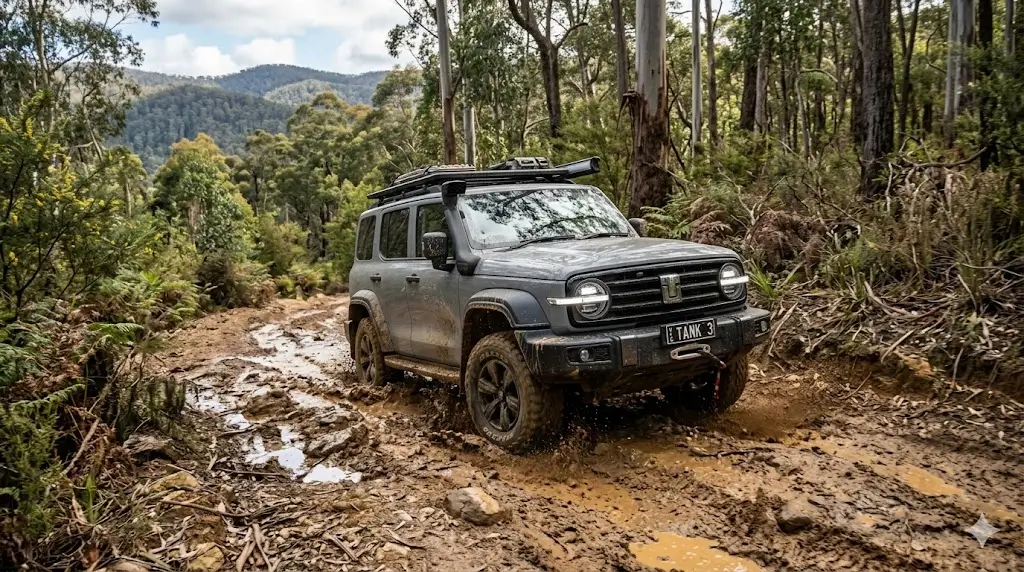

Last week, my Australian friend Mark sent me a photo: his Tank 300 parked at the top of a dune in the Simpson Desert, with endless red outback behind it.
The caption was just one sentence: This car was worth it.
Mark is a typical Australian off-road enthusiast. He previously drove a Jeep Wrangler — too expensive; considered a Toyota Prado — too expensive; finally chose the Tank 300, spending less than AUD 50,000.
Three months later, he told me this was the most correct decision he’d ever made.
Why the Tank 300?
In Australia, off-roaders aren’t just transportation — they’re a lifestyle. Weekend desert crossings, holiday caravan towing, after-work beach fishing — these scenarios need a vehicle that can genuinely go off-road.
The problem: traditional choices are all too expensive.
Jeep Wrangler starts at AUD $67,450, Toyota Prado $72,480, Ford Everest $53,440. For most Australian families, these numbers mean years of mortgage pressure.
The Tank 300 starts at AUD $47,990. Nearly $20,000 cheaper than the cheapest Wrangler.
But cheap doesn’t mean low quality. Mark listed me a set of numbers:
Look, what can you buy at the same price point? The Isuzu MU-X has only one rear locker, Ford Everest also one locker. The Tank 300 Ultra version has front and rear lockers. This extra locker is the difference between getting out of the desert or not.
Real Performance in the Desert
Mark took me through a desert crossing. This was the first time I truly understood the Tank 300’s value.
The Simpson Desert is not a sandbox in a park. It’s the world’s largest parallel dune system, with dunes over 30 meters high, stretching hundreds of kilometers. Getting bogged here is routine; recovery is an essential skill.
When we drove to the first big dune, Mark switched 4WD to 4L (low-range four-wheel drive) and pressed the rear diff lock button. Watch, he said, no need to rush, just drive up slowly.
A light touch on the throttle, and the Tank 300 climbed to the dune top step by step like a steady camel. No wheel slip, no struggle, not even obvious tire sink. This combination of 2.48x torque amplification + rear lock provides almost infinite traction at low speed.
On the downhill, Mark turned on off-road cruise control. The system automatically controlled the speed; he just had to hold the steering wheel. Before, driving the Wrangler I had to keep my foot on the brake to control speed — my legs went numb. Now my feet are free; just focus on looking at the road.
The Diesel’s Charm
Mark chose the diesel version. I asked him why.
Three reasons: torque, fuel consumption, towing capacity.
The diesel version’s peak torque is 480N·m, all available from 1700rpm. For desert crossings and long-distance towing, low-end torque matters more than power.
On fuel consumption, Mark measured a real composite of about 8L/100km. With a 75L fuel tank, range exceeds 900 km. In the Australian outback, fuel stations can be hundreds of kilometers apart. Range is peace of mind.
Towing capacity is 3000kg. Mark’s caravan weighs about 2.2 tonnes, and the Tank 300 tows it effortlessly. The hybrid version has stronger power, but towing capacity is only 2500kg. If you want to tow a big caravan, the diesel is the only choice.
The Hybrid’s Temptation
But when I asked Mark whether he regretted not choosing the hybrid version, he hesitated.
The hybrid is indeed fierce. 255kW power, 648N·m torque, 0-100km/h in just over 7 seconds. It drives like a performance SUV, not an off-roader.
Another advantage of the hybrid is city commuting. EV mode supports low-speed pure electric driving up to 40km/h, with almost no delay in torque response from standstill. If you mainly drive in the city and only occasionally go off-road on weekends, the hybrid is the better choice.
But the hybrid’s shortcomings are also obvious: weight increased by 150kg, price higher by AUD $8,000, towing capacity decreased. For true off-road players, these trade-offs may not be worth it.
Interior: Unexpected Luxury
Sitting in the Tank 300’s cabin, the first feeling is: this doesn’t feel like a car under AUD 50,000.
Round air vents, simulated clock, aircraft-style gear lever — these design elements obviously borrowed from the Mercedes G-Class. Of course, the Tank 300’s price is only one-third of the G-Class’s.
12.3-inch LCD instrument cluster and 12.3-inch center screen are standard. Wireless Apple CarPlay connects smoothly, navigation and music both display on screen. Mark said with a laugh: Off-road vehicle interiors used to be all ugly — as long as they could run. Now Chinese brands have turned off-roaders into luxury cars.
Not Without Issues
After three months, Mark also found some gripes with the Tank 300.
The lane-keeping assist is too aggressive. The car drifts to the left side of the lane; when it encounters solid lines it forcibly pulls you back. The first time it happened I was startled — I thought the car was out of control.
Luckily this function can be turned off in settings, but it has to be redone after every vehicle restart. GWM says it will be optimized in OTA updates, but for now it’s still annoying.
Another problem is rear space. Legroom is enough, but can’t be called generous. If you have two tall kids at home, long trips might be a bit cramped.
Brand awareness is also an issue. Friends saw this car for the first time and asked what brand it was. I said it’s Chinese Great Wall, and they were a bit surprised. But after driving it they all recognize its capability.
Compared to the Wrangler, Where’s the Gap?
I asked Mark: if the budget were sufficient, would he choose the Wrangler?
He thought about it and said: The Wrangler wins on brand and culture. Driving a Wrangler, you feel like you’re part of that circle. Driving a Tank 300, you need to prove to others whether this car is capable.
But purely looking at the product, the Tank 300 doesn’t lose obviously to the Wrangler. Off-road capability, configuration, comfort — even better. The AUD 20,000 saved is enough to upgrade a top-tier suspension, swap four big tires, add a lift kit.
In the end, are you buying a brand, or buying a car?
My Verdict
Mark is a typical Tank 300 user: loves off-roading, limited budget, doesn’t blindly follow brands.
For this kind of user, the Tank 300 is currently the highest value-for-money choice on the market. Front and rear diff locks, part-time 4WD, Tank U-turn, ladder frame chassis — these hardcore off-roading essentials are all there. Interior luxury and tech configuration even surpass Japanese competitors at the same price point.
Of course, it’s not perfect. Driver assist calibration is over-aggressive, rear space is middling, brand awareness needs time to accumulate. But if what you truly need is a vehicle that can take you across deserts, tow caravans, weekend fishing — not a badge to show off — the Tank 300 deserves serious consideration.
Mark’s photo is still in my album. That Tank 300 parked at the dune top, behind it the red sky of the Australian outback. This scene says it all.
— Sources: User interview, CarExpert, 4X4 Australia, GWM Australia official site (March 2026)