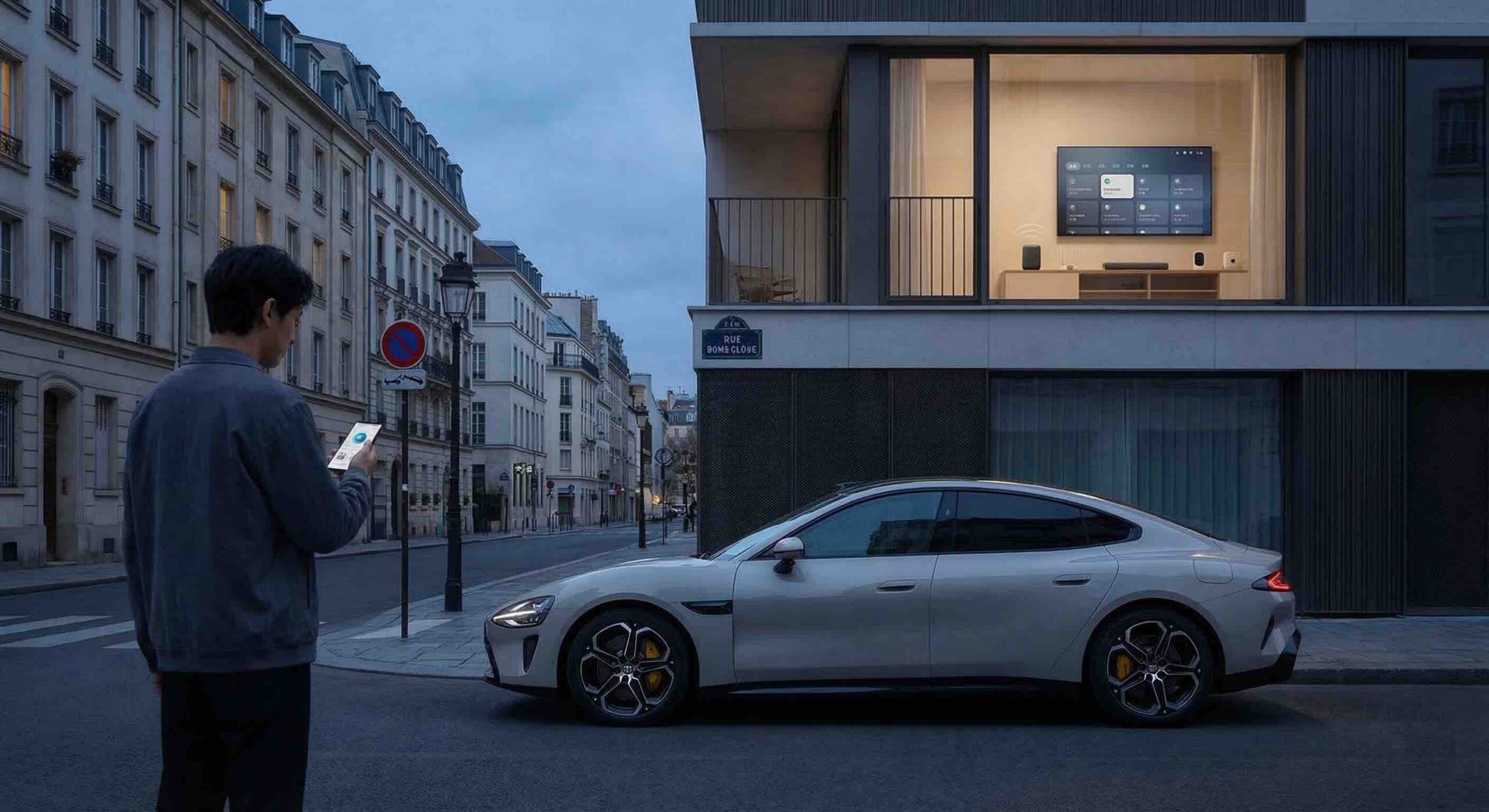

In October 2025, a European car vlogger posted a video on social media. He had just brought back a Xiaomi SU7 Ultra from China and set the fastest lap time for a production EV at the Nurburgring.
The comment section exploded. Half the people were asking “When can we buy this car in Europe?” and the other half were asking “Isn’t Xiaomi a phone company?”
I have heard that question for many years. Since LeEco announced its car-making ambitions in 2014, every company attempting to cross over has had to face the same doubt: what makes you qualified?
Xiaomi’s answer is simple: the ecosystem.
Lei Jun calls it “Human-Car-Home Full Ecosystem”. It sounds like marketing speak, but after driving the SU7 for two weeks, I started to understand what he meant.
A Xiaomi Phone on Wheels
The moment I sat in the SU7’s driver’s seat, I felt like I had sat inside a giant Xiaomi phone.
This is not a pejorative. The HyperOS UI and interaction logic are almost identical to a Xiaomi phone. If you have used a Xiaomi phone, this car has zero learning curve. From adjusting the air conditioning to switching music, from navigation to checking vehicle status, every operation falls within muscle memory.
What truly amazed me was the cross-device connectivity. When my Xiaomi phone approached the car, the infotainment system automatically recognized it and synced my navigation destination, music playlist, and calendar reminders. This function is not new, but the SU7 does it more smoothly than any other car — no pairing process, no delay, as if the phone and the car were always one.
Even more exaggerated is the smart home integration. Driving the SU7 home, my home air conditioner had already set the temperature to my preference, the air purifier had started in advance, and the robot vacuum knew I was almost home and returned to its dock. This is not science fiction — this is the real experience of the Xiaomi ecosystem chain.
Here comes the question: does this experience mean anything outside China?
What Are Europeans Buying When They Buy the SU7?
Xiaomi plans to enter overseas markets in 2027. But European consumers facing the SU7 will see a completely different product.
First is the voice assistant. Xiao Ai is the core interaction method of HyperOS, but its capabilities are built on Chinese semantic understanding. Dialect recognition, contextual association, scenario-based recommendations — these advantages Xiao Ai has accumulated over years in the Chinese market need to start from zero in Europe. Xiaomi has two choices: keep optimizing Xiao Ai’s multilingual capabilities, or cooperate with Google Assistant and Amazon Alexa. The former takes time; the latter means giving up ecosystem leadership.
Second is the app ecosystem. HyperOS’s built-in app store serves the Chinese market, and the Spotify, YouTube Music, and Waze that European users are used to need re-adaptation. More importantly, the core services that make the “Human-Car-Home Full Ecosystem” work — online music, local lifestyle services, smart home control — either don’t exist in Europe or Xiaomi has no access rights.
A Xiaomi phone user working in Dubai told me that after buying an SU7 to experience car-home connectivity, he found that less than 30% of the Xiaomi smart home products available locally were what you could buy domestically. “Human-Car-Home” became just “Human-Car” — the ecosystem integrity was heavily discounted.
So, Europeans buying the SU7 are not buying the “ecosystem” — they are buying a “good car to drive”.
Then Let’s Talk About the Car Itself
Ecosystem aside, how is the SU7 as an EV?
The answer is: pretty good, with no obvious weaknesses.
The standard version has a 73.6 kWh BYD Blade battery with 700 km CLTC range. In a highway test (120 km/h speed limit, average speed 97.7 km/h), the real range was about 495 km — a 70% achievement rate. Winter range gets discounted: at 3–7°C running the heater on the highway, the real range is about 520 km. These figures are normal among same-class EVs — not stunning but sufficient.
For charging, the whole lineup supports 800V high-voltage fast charging, adding about 350 km of range in 15 minutes. That speed is practical enough for European highway service areas — by the time you finish a coffee, the car is charged.
Driver assistance is another topic. The SU7 Pro and Max come standard with a 128-line lidar, supporting city NOA. Highway NOA performance is stable, with lane changes, overtakes, and detours becoming increasingly decisive; but urban navigation assistance still feels “timid” in complex road conditions, frequently requesting takeover when facing uncertain situations.
Xiaomi has set up an R&D center of fewer than 50 people in Munich, Germany, focused on driver-assistance localization. European city roads are narrower, have more roundabouts, and pedestrians and cyclists have higher right-of-way — all of these require retraining models. Is two years enough? I don’t know. But Xiaomi is at least doing the right thing.
Compared with the Model 3, Which Is the Better Buy?
This question becomes very real in the European market.
The SU7 standard version is priced at 215,900 yuan domestically (about €28,000), but the EU’s countervailing duties on Chinese EVs can reach up to 37.6%. After tariffs, the SU7’s price in Europe could approach €40,000 — that price directly challenges the Model 3.
The Model 3’s advantages: supercharger network coverage (over 12,000 supercharger stalls in Europe), brand recognition, and the long-term imagination space of FSD. These are things the SU7 cannot catch up with in the short term.
But the SU7 has its own selling points: leading smart cockpit experience, ecosystem connectivity (if you use a Xiaomi phone), and more aggressive localization services. For European tech enthusiasts and users who want to try something “different”, the SU7 is an attractive option.
What Do Middle Eastern Tycoons Think?
Interestingly, the SU7’s appeal in the Middle East market may be stronger than in Europe.
Gulf consumers are not price-sensitive — they care more about performance, brand rarity, and social attributes. The production EV lap record the SU7 Ultra set at the Nurburgring is extremely attractive to Middle Eastern tycoons — far sexier than the “ecosystem” concept.
Media reported that after the SU7 launched domestically, a large number of auto traders resold it to the Middle East, making 30,000–60,000 yuan per car in price differences. This shows from one angle: in front of the right audience, the SU7 has a market.
My Verdict
The Xiaomi SU7 is a good car. This has already been validated in the Chinese market — in Q1 2025, the SU7’s market share in China’s C-segment market reached 8.13%, ranking first.
But whether the “Human-Car-Home Full Ecosystem” can be successfully replicated overseas depends on where you stand.
If you are a Chinese consumer, use a Xiaomi phone, and have Xiaomi smart home devices at home, the SU7 is currently one of the pure-electric sedans most worth considering. The ecosystem integration experience is something no other brand can give you.
If you are a European consumer, not living in China, not using the Xiaomi ecosystem, then the SU7 is, to you, just an EV that is “decent but without ecosystem advantages”. Whether to buy it depends on how much you crave being “different”.
What Xiaomi does best is carving a bloody path out of places others deemed impossible. Europe in 2027 will prove whether they can succeed this time.
— Sources: Xiaomi official data, AutoQuality Network, Autohome, InsideEVs (March 2026)