What does the MG brand mean to British people?
My dad’s generation would tell you that MG is a British legend on the racetrack, the red afterimage of an MGB drifting through country lanes. And all my generation can tell you is: MG is Chinese now.
On October 31, 2025, MG delivered its 100,000th electric vehicle in the UK. The story behind this number is more interesting than the number itself: a fallen aristocrat acquired by SAIC took six years to complete the transformation from combustion to electric — and did it on its former “home turf” — the UK.
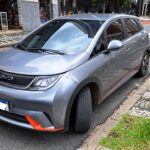
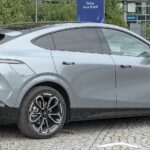
The MG4 is the protagonist of this transformation. This electric hot hatch with a starting price under £30,000 became the second best-selling EV in the UK in 2023, behind only the Model Y. In 2024, MG ranked tenth in UK car brand sales with a 4.18% market share.
Calling it a victory for Chinese EVs? That is too simple. It looks more like a complex identity experiment: when a British soul is fitted into a Chinese-made body, what happens?
Rear-Wheel Drive: A Choice About “Identity”
Let me start with a technical detail: the MG4 is rear-wheel drive.
In the 2026 electric hatchback market, what does rear-wheel drive mean? It means you are not a “grocery getter”. The VW ID.3 uses a torsion-beam rear suspension, the Nissan Leaf is front-wheel drive, the Renault Megane E-Tech is also front-wheel drive. Rear-wheel drive plus multi-link suspension — that combination is usually the preserve of premium brands — the BMW 3 Series, the Mercedes C-Class, or more expensive EVs.
Why did MG make the MG4 rear-wheel drive? The official line is “driving fun”. But I have another theory: MG needed to prove itself.
For an acquired brand, the biggest dilemma is not technology — it is identity. What makes you still MG? A badge? Not enough. You need to speak with the product, speak with the things that make old MG enthusiasts nod. Rear-wheel drive is such a choice — it pays homage to history while making a statement about the future.
I test-drove the MG4 Extended Range on a winding country lane in southern England. The steering felt heavier than I expected, and its steering precision has almost no rivals among EVs at this price point. The rear axle shows a playful tendency to slide at the limit — not losing control, but a confidence of “I can be naughty”.
Top Gear’s review said: “Its driving fun exceeds what its price would suggest.” That phrasing is a bit euphemistic. To put it more bluntly: the MG4 doesn’t drive like a £30,000 car — it drives more like a £40,000 car. That is the magic of rear-wheel drive plus multi-link.
Price: The Chinese Answer to Value Aesthetics
The MG4’s pricing strategy is, at its core, a story about “scale”.
The Long Range is £29,995, the Extended Range £32,995. A comparably equipped VW ID.3 costs nearly £10,000 more. The Cupra Born is even pricier. A Tesla Model 3 is about double the MG4’s price.
How can MG price it like this?
The answer hides in two numbers: first, global MG4 sales have surpassed 200,000 units, making it the best-selling Chinese EV export single model of 2023; second, the SAIC Group owns a complete vertical supply chain in China — from batteries to motors to chips, almost entirely “internal circulation”.
This is not magic, it is economies of scale. When you build 200,000 cars a year, your battery procurement unit price, mold amortization costs, and R&D expense apportionment are all a fraction lower than a rival building 50,000 cars. MG passed the saved costs directly to consumers.
But low price does not equal “cheap”. The MG4’s investment in driving feel proves it is not an EV that is just “good enough to drive”. It is an EV that is “fun to drive”. That distinction is understood by anyone who has driven one.
XPower: Strap a Rocket Engine to a Hot Hatch
If you find the regular MG4 too tame, the XPower version will redefine “excess” for you.
435 horsepower, 600 Nm of torque, 0–100 km/h in 3.7 seconds, £33,995. Five years ago this combination was almost impossible — you either bought a ridiculously expensive performance car or accepted a sluggish EV.
What does the XPower’s 3.7 seconds mean? A Porsche Macan Turbo does 3.9 seconds. The Cupra Born VZ is close to 4 seconds, but costs £12,000 more than the XPower.
But speed comes at a price. The XPower’s battery capacity is “only” 61.7 kWh, with a WLTP range of 251 miles. In spirited driving, that number shrinks faster. And the AWD system doesn’t make the XPower more fun than the rear-drive version — the suspension is firmer, the steering feel is about the same, and the only difference is you can floor it more recklessly on slippery roads.
Evo magazine’s verdict is sharp: “The XPower is fast, but its cornering performance is no better than the rear-drive version, while its range shrinks. Unless you frequently drive on slippery roads, its point is limited.”
My advice: if you are a performance enthusiast, the XPower is worth experiencing once. But if you will commute in it daily, do school runs, and take weekend trips, the regular Extended Range may be the more rational choice. After all, “speed” is an occasional experience — “range” is a daily concern.
Interior: The Soft Spot of Chinese Manufacturing?
I don’t want to whitewash this: the MG4’s interior quality is its biggest weakness.
Sit in the driver’s seat and you can immediately feel the traces of cost control. The dashboard is full of hard plastics, the door panels don’t feel premium enough, and the seats’ support is average. Placed side by side with the VW ID.3 or Cupra Born, the gap is obvious at a glance. The Germans do spend money on the places “you can’t see”.
The infotainment system is another complaint. The 2026 model upgraded screen size and UI design, but in smoothness and feature richness, the gap with Tesla and VW still exists. CarPlay connections occasionally drop, navigation route planning is not smart enough, and voice recognition accuracy needs improvement.
But the question is: are these “soft power” gaps worth £10,000?
If you spend two hours in the car every day, you might say yes. Interior quality, seat comfort, sound system — these things get perceived repeatedly in daily use.
But if you buy a car to get from A to B, occasionally driving to the supermarket on weekends, then the MG4’s interior being “good enough” is enough. The £10,000 saved is enough to charge the car for many years, or buy a better sound system.
Rivals: Where Does the MG4 Stand?
In the UK market for compact electric hatchbacks, the MG4 has three main rivals: the VW ID.3, the Cupra Born, and the Kia EV4.
The VW ID.3 is the most direct competitor. Same size, same rear-drive layout, a platform from the same large automotive group. But the ID.3 starts above £35,000 — nearly £10,000 more than the MG4. You have to ask yourself: is the VW badge worth £10,000?
The Cupra Born is essentially a re-skinned ID.3, but with a sportier tune. The VZ version’s performance approaches the MG4 XPower, at £46,000 — £12,000 more than the XPower. That price difference could buy a used combustion hot hatch.
The Kia EV4 is a 2025 newcomer, front-wheel-drive layout, comfort-oriented. Starting above £32,000, its range is about the same as the MG4, but its driving fun is clearly inferior to the rear-drive MG4.
To sum it up in one sentence: the MG4 has almost no rivals in value-for-money. Its weaknesses are the interior and brand premium, but if you don’t care about those, it is the most rational choice.
The UK: The Best Testing Ground for Chinese EVs
The MG4’s success in the UK is not just a product’s success, but also the result of a market choice.
The UK is one of the few European countries with a relatively open attitude toward Chinese EVs. No strict subsidy thresholds like France (requiring batteries to be made in Europe), no strong traditional auto unions like Germany — the UK EV market is relatively free. MG fully exploited this window, building over 400 sales outlets across the UK within a few years, covering the whole country.
More importantly, the UK’s urban environment is naturally suited to compact hatchbacks. London, Manchester, Birmingham — the roads in these cities are narrow and parking spaces are tight. The MG4’s 4.3-metre length fits these cities perfectly.
Of course, challenges are coming. BYD, Nio, and Xpeng are all accelerating into the UK market. Traditional European carmakers are also fighting back — the facelifted VW ID.3 is on the way, and an upgraded Renault Megane E-Tech is brewing. Whether the MG4 can stay ahead depends on whether MG can maintain the balance between cost and technology.
My Verdict
The MG4 is not a perfect car. Its interior quality is a pity, the infotainment system has room for improvement, and rear-seat space is unfriendly to tall people.
But it is a car with a “soul”. At this price point, it chose rear-wheel drive instead of the cheaper front-wheel drive, multi-link suspension instead of torsion beam, driving fun instead of pure cost optimization. These choices make the MG4 different — it is not just another Chinese-made product, it is a redefinition of the MG brand.
When a British soul is fitted into a Chinese-made body, the result is surprisingly good. The MG4 proves: brand ownership doesn’t matter, product strength does. What you drive is a good car to drive — not a car that “belongs to” someone.
— Sources: Top Gear, Parkers, What Car?, Electrifying, MG official data, SMMT statistics (March 2026)