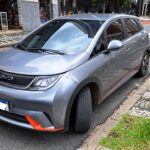
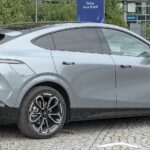
Four motors, 1,265 horsepower, 0–100 km/h in 2.07 seconds — I had read the Zeekr 001 FR’s numbers countless times. But the moment I sat in the driver’s seat, held the brake with my left foot, floored the throttle with my right, and released the brake, I still underestimated physics’ malice.
My vision narrowed in that instant. Blood was flung from my head toward my back. Before the adrenaline even had time to secrete, the instrument cluster already read 140 km/h. The whole process took less than four seconds, and my life completed a cognitive reconstruction in those few seconds.
This is not a car. This is an engineering experiment redefining “excess horsepower”.
The Geometry of Quad Motors
I have seen too many dual-motor EVs. One motor per axle, distributing power to two wheels through a driveshaft — that is the standard formula for most high-performance EVs today. Simple, efficient, cost-controllable.
But Zeekr did something crazy with the 001 FR: they stuffed a motor next to each wheel.
What does that mean?
Imagine you are cornering. A traditional AWD car’s power distribution is decided by the central differential and electronic control systems, and from the engine or motors to the wheels, there is at least tens of milliseconds of delay and mechanical loss in between. But in a quad-motor system, each wheel has its own independent power source, and response time can be compressed to the millisecond level.
Zeekr calls this system ZVC — Zeekr Vectoring Control, torque vectoring control. The official claim is peak wheel-end torque of up to 10,000 Nm. That number looks like bragging at first glance, but think about it carefully: four motors each outputting around 320 Nm of torque, amplified by reduction gears before reaching the wheels, can indeed approach that figure.
But what interests me is not the peak numbers — it is the control logic.
What does each wheel being independently driven mean? It means the car can give the outer wheels more torque and the inner wheels less, or even reverse torque, in a corner, thereby generating an additional yaw moment. This is not something a differential can do — this is active torque vectoring control.
I tried it on the track. At T1, heavy braking before turn-in, steering wheel turned left, right foot lightly touching the throttle — the nose felt as if it was “dragged” into the apex. It is a very strange sensation, like someone helping you turn the steering wheel. The two rear motors were adjusting torque distribution in real time based on my steering angle and throttle depth.
Tank Turn: Showboating or Utility?
The 001 FR has a much-talked-about feature: the tank turn. Left and right wheels rotate in opposite directions, and the whole car spins 360 degrees on the spot.
When I first saw the demo video, I admit I was a bit dismissive. Isn’t this just a marketing gimmick? Who would ever use this feature in daily driving?
But at the track day rest area, I met another 001 FR owner. He showed me a scenario: his parking spot was sandwiched between two badly parked cars, with less than 30 cm of clearance front and back. Normally, in that situation, all you can do is wait for the other owners to move their cars.
He switched on tank-turn mode.
Steering wheel at full lock, holding the confirm button, the car started rotating in place. Seconds later, the nose was pointing toward the exit. He pressed the throttle and drove away calmly.
OK, I take back my earlier judgment. This is not showboating — it is genuinely useful in specific scenarios. As long as you can accept the stares of passersby while spinning in a public parking lot.
The Carbon-Ceramic Cold-Start Dilemma
Power done, let’s talk brakes. The 001 FR comes standard with Brembo carbon-ceramic discs and AP Racing 10-piston calipers. On an ICE supercar, this setup usually costs an extra 100,000–200,000 yuan.
The advantages of carbon-ceramics are obvious: light, heat-resistant, fade-resistant. After several hot laps, regular discs already start to go soft, while carbon-ceramics still maintain stable braking force.
But carbon-ceramic brakes have a rarely mentioned drawback: poor low-temperature braking performance.
On the first morning, leaving the hotel, the temperature was 12°C. First brake, pedal pressed down, and the braking force was much weaker than I expected. For a moment I thought the brakes were broken. Only later did I remember that carbon-ceramic brakes need to reach operating temperature to deliver their best performance. And in street driving, disc temperature rarely gets up there.
This is not a fault, it is a material property. But for drivers used to regular discs, the “soft first few presses” experience takes adaptation. I advise anyone considering carbon-ceramic brakes to leave extra braking distance when the car is cold.
Suspension: The Track-Street Compromise
KW coilovers. This is a thundering name in the tuning world, and the 001 FR has them as standard equipment.
Adjustable damping, adjustable ride height, track-grade support. On the track, this suspension’s performance is beyond reproach. Body roll is suppressed very well in high-speed corners, steering is precise, and the tail follows excellently.
But what is the cost?
On the road from the track to the hotel, there was a section of rough concrete road. In comfort mode, I could still feel every seam and pothole. The body had no excess sway, but road information was delivered 100% to my rear end.
This is not “uncomfortable” — it is “too honest”. If you are used to having road information filtered by the suspension, the 001 FR will make you feel the world has suddenly become very coarse. But if you love driving, love knowing what each wheel is experiencing, this suspension will get you addicted.
Range Anxiety, or Charging Anxiety?
A 100.01 kWh Qilin battery, 550 km CLTC range. For a performance car, that number is not bad.
But CLTC is just a reference. In track mode, in those seconds when I floored the throttle, the range number visibly dropped. After one track day, the battery went from 95% to 35%, and I had covered less than 100 km.
That is obviously not normal — track driving is the most power-hungry scenario there is. But it also reminds us: for a 1,265 hp car, range is always a dynamic variable. You can drive 550 km, or you can drain the battery within 100 km — it depends on your right foot.
The good news is the charging speed of the 800V platform. The official figure for 10% to 80% is 15 minutes, and real-world experience confirms it can do this at Zeekr’s charging stations. But the question is: where are the Zeekr charging stations?
In my city, the nearest Zeekr charging station is about 40 km from the track. That means if I run the battery empty at the track, I either call a tow truck or find a third-party charger on the road and accept the fate of slow charging.
769,000 Yuan — What Are You Buying?
I have been asking myself this question since the first day of ownership.
What can 769,000 yuan buy? A base Porsche Taycan, a used 911, or a brand-new Zeekr 001 FR.
From a brand perspective, there is still a long distance between Zeekr and Porsche. Resale value, brand premium, social recognition — these intangibles are things Zeekr cannot give you for now.
But from a product perspective, what the 001 FR gives far exceeds its price. Quad motors, carbon-ceramic brakes, KW dampers, a 100 kWh Qilin battery — if you bought these configurations separately, the cost would be far beyond 769,000 yuan.
More importantly, the 001 FR gives an experience. A confidence of “I can”. When I drive it to overtake, corner, and fight alongside more expensive cars on the track, I know this car has not let its price down.
Who Should Buy This Car?
I cannot give a standard answer.
If you ask my recommendation, I would say: go test drive it. Not the lazy loop around city streets, but the track — push the car to its limit, then ask yourself two questions:
First, can you handle 1,265 horsepower?
Second, can you accept its flaws — the carbon-ceramic cold-start dilemma, the firm suspension, the insufficient brand social recognition?
If both answers are yes, congratulations — you have found a driving machine worth owning.
If you have any hesitation, think again. This is not a car you need to adapt to — it is a car you need to conquer.
— Sources: Zeekr official technical documentation, track test experience (March 2026)