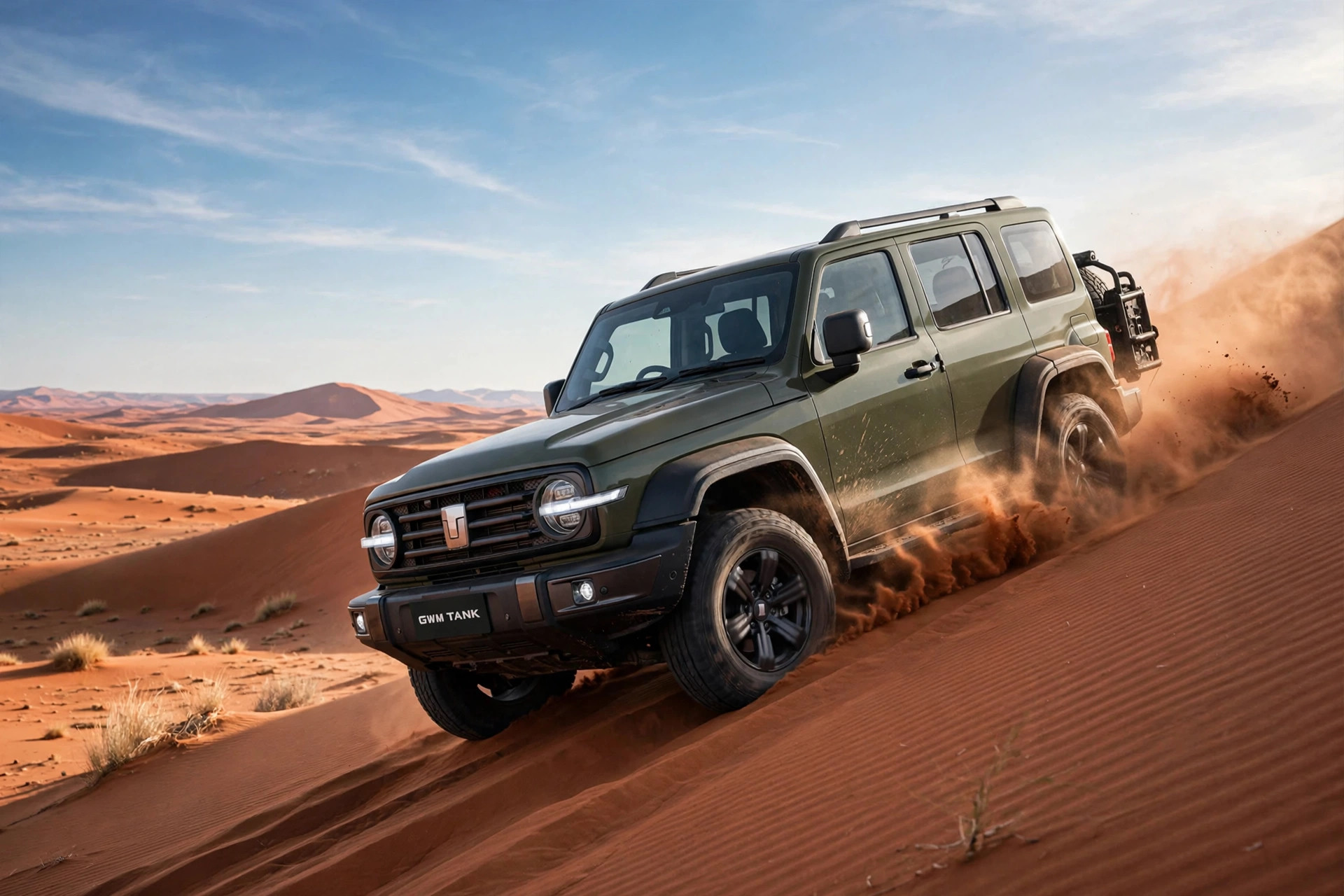

Last week, my Australian friend Mark sent me a photo: his Tank 300 parked atop a dune in the Simpson Desert, an endless red wilderness behind it.
The caption was one sentence: “Worth every cent.”
Mark is a typical Aussie off-road enthusiast. He’d driven a Jeep Wrangler — too expensive. Considered a Toyota Prado — too expensive. Ended up with a Tank 300 for under AUD 50,000.
Three months later, he told me it was the best decision he’d ever made.
Why the Tank 300?
In Australia, a 4WD isn’t just transport — it’s a lifestyle. Weekend desert crossings, holiday caravan towing, after-work beach fishing: these demand a vehicle that can genuinely go off-road.
The problem: the traditional choices all cost too much.
A Jeep Wrangler starts at AUD 67,450. A Toyota Prado at AUD 72,480. A Ford Everest at AUD 53,440. For most Australian families, those numbers mean years of mortgage stress.
The Tank 300 starts at AUD 47,990 — nearly AUD 20,000 less than the cheapest Wrangler.
But cheap doesn’t mean nasty. Mark gave me the numbers:
“Look at what you get at this price. An Isuzu MU-X has one rear locker. A Ford Everest has one locker. The Tank 300 Ultra has front AND rear lockers. That extra locker is the difference between getting out of the desert and not.”
Real Performance in the Desert
Mark took me on a desert crossing. It was the first time I truly understood the Tank 300’s value.
The Simpson Desert isn’t a sandbox in a park. It’s the world’s largest parallel dune system — dunes over 30 meters high stretching hundreds of kilometers. Getting bogged is routine here; recovery is a mandatory skill.
At the first big dune, Mark shifted to 4L (low range) and hit the rear diff lock button. “Watch,” he said. “No need to charge it. Just crawl up.”
A light touch on the throttle and the Tank 300 climbed the dune like a steady camel — no wheelspin, no struggle, barely any tire sink. The combination of 2.48x torque multiplication and the rear locker delivers near-limitless traction at low speed.
On the way down, Mark engaged off-road cruise control. The system managed speed automatically; he just steered. “In the Wrangler I was on the brakes the whole descent — my legs were killing me. Now my feet are free and I can focus on the track.”
The Diesel’s Appeal
Mark chose the diesel. I asked why.
“Three reasons: torque, fuel economy, towing.”
Peak torque is 480 N·m, delivered across the 1,500–2,500 rpm band (per Australian official specs). For desert work and long-distance towing, low-end torque matters more than power.
On fuel, Mark measured around 8L/100km in mixed use. With a 75L tank, range exceeds 900 km. “In the outback, fuel stops can be hundreds of kilometers apart. Range is peace of mind.”
Towing is rated at 3,000 kg. Mark’s caravan weighs about 2.2 tonnes — the Tank 300 pulls it effortlessly. “The hybrid is more powerful but only tows 2,500 kg. If you’re hauling a big van, diesel is the only choice.”
The Hybrid Temptation
But when I asked Mark if he regretted not getting the hybrid, he hesitated.
“The hybrid is properly quick. 255 kW, 648 N·m, 0–100 km/h in just over 7 seconds. It drives like a performance SUV, not an off-roader.”
The hybrid’s other advantage is city commuting. EV mode handles low-speed electric driving up to 40 km/h, with near-instant torque response off the line. If you mostly drive in the city with occasional weekend off-roading, the hybrid is the better pick.
But the hybrid’s compromises are real: heavier, around AUD 5,000 more expensive (2025 model; the gap varies by model year — check dealer quotes), and lower towing capacity on older model years. For serious off-roaders, those trade-offs don’t always add up.
Interior: Unexpected Luxury
Climbing into the Tank 300’s cabin, the first impression is: this doesn’t feel like a sub-AUD 50,000 car.
Round air vents, an analogue clock, an aircraft-style gear lever — the design cues clearly borrow from the Mercedes G-Class. Of course, the Tank 300 costs a third of a G-Wagen.
Twin 12.3-inch screens (instruments and infotainment) are standard. Wireless Apple CarPlay connects smoothly, with navigation and music on the display. Mark laughed: “Off-roaders used to have agricultural interiors — as long as it worked. Now Chinese brands are making them feel luxurious.”
Not Without Flaws
Three months in, Mark found some annoyances.
“The lane-keep assist is too aggressive. The car drifts left in the lane, then yanks you back at solid lines. First time it happened I thought something was broken.”
You can turn it off in settings, but it resets every time you start the car. “GWM says an OTA update will fix it, but for now it’s annoying.”
Rear space is another gripe. “Legroom is adequate, but not generous. Two tall kids on a long trip might feel cramped.”
Brand recognition is an issue too. “Friends see the car and ask what brand it is. When I say Chinese GWM, they’re surprised. But after a drive, they respect what it can do.”
Against the Wrangler, Where Does It Lose?
I asked Mark: with an unlimited budget, would he pick the Wrangler?
He thought about it. “The Wrangler wins on brand and culture. Driving a Wrangler, you feel part of the tribe. With the Tank 300, you have to prove the car to people.”
“But on product alone, the Tank 300 loses nothing to the Wrangler. Off-road ability, equipment, comfort — arguably better. The AUD 20,000 you save buys a high-end suspension upgrade, four big tires, and a lift kit.”
“At the end of the day: are you buying a badge, or buying a car?”
My Verdict
Mark is the archetypal Tank 300 buyer: loves off-roading, limited budget, doesn’t follow badges blindly.
For buyers like him, the Tank 300 is a high-value option on the Australian market worth serious consideration. Front and rear diff locks, part-time 4WD, tank turn, body-on-frame construction — all the hardcore off-road essentials are here. Interior luxury and tech even surpass Japanese rivals at this price.
It’s not perfect, of course. The driver assists need calibration, rear space is merely adequate, and brand awareness takes time. But none of those are deal-breakers.
If you want solid off-road capability for relatively little money in Australia, it’s worth serious consideration.